Insurance Verification Workflows for Telehealth Appointments
Patient location and modality changes upend verification workflows built for fixed addresses.
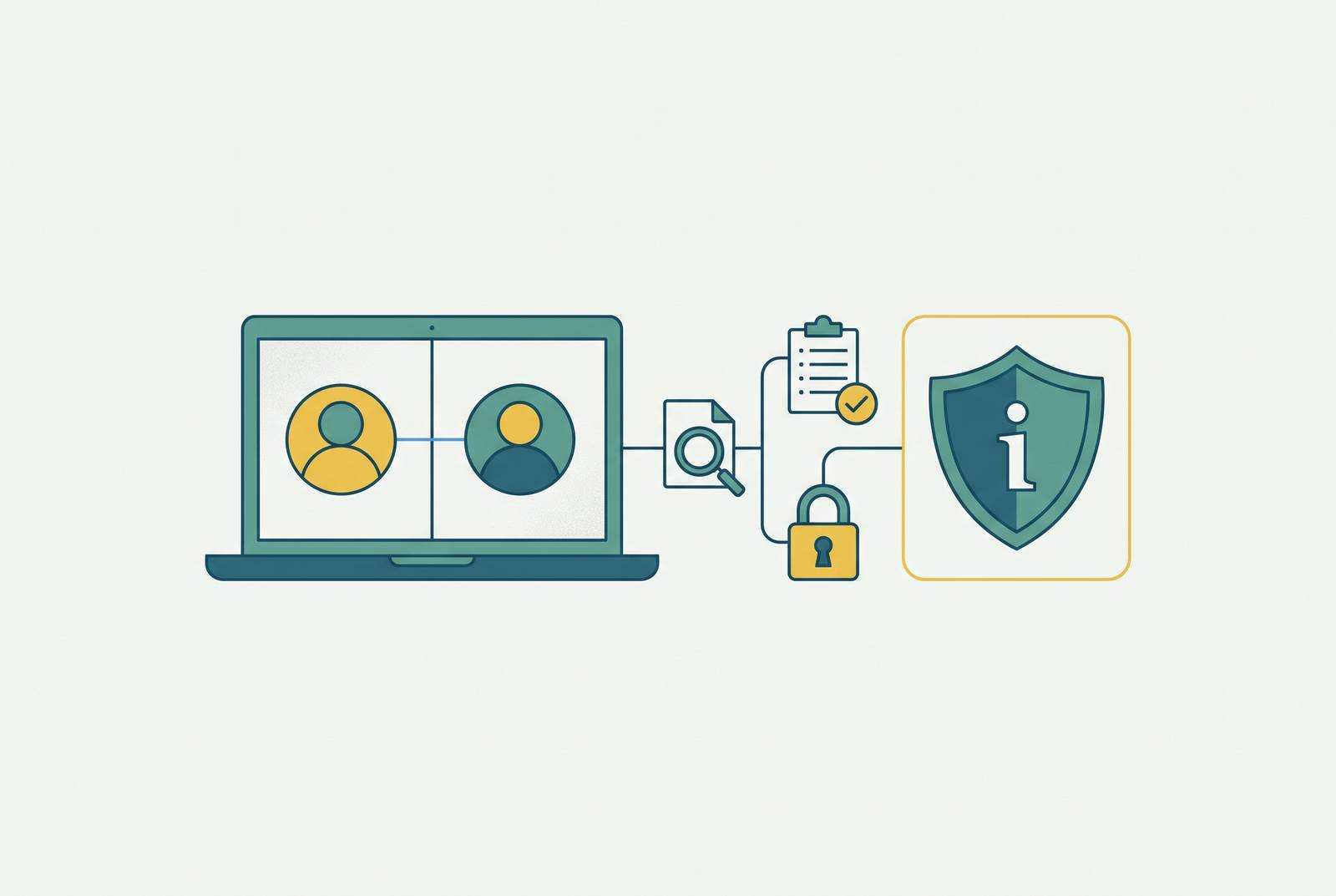
Insurance verification for telehealth appointments fails because the workflow it relies on was built for a world where the patient, the provider, and the payer's rules all lived in one fixed place, and that mismatch is what produces the failure. Virtual care breaks that assumption without changing the paperwork that depends on it, so practices keep running a verification process designed for a geography that no longer applies to a growing share of their visits.
Why telehealth verification keeps failing despite standard eligibility checks
The failure does not happen at the moment a claim gets submitted. It happens earlier, at scheduling or at the initial coverage check, and by the time a claim goes out the door, the error is already locked into the record. Standard verification confirms that coverage is active, that the provider sits in network, and what the patient owes toward copay and deductible. Those checks matter for an in-person visit, and they remain necessary for a telehealth visit, but they stop well short of sufficient. A virtual encounter adds questions a front desk built around a waiting room never had to ask: where is the patient physically sitting during the call, what technology is carrying the visit, and which state's licensing rules govern the provider at that moment.
Each of those questions feeds a specific billing decision downstream, including the Place of Service code, the modifier attached to the claim, and whether the treating practitioner is even eligible to bill for that encounter. Coding staff and billers need that underlying variable captured first, since none of those decisions can be made correctly without it. Coding staff cannot select POS 02 or POS 10 from guesswork, and a biller cannot retroactively determine what state a patient was sitting in three weeks after the appointment ended.
Medicare guidance treats a patient's location at the time of the encounter as both a billing detail and a compliance matter, one that has to be confirmed at every single appointment rather than copied forward from the last visit on file. A patient might connect from a home office on Monday and a hotel room on a work trip by Thursday, and each of those locations can change which POS code applies and which state's licensing rules govern the visit. A verification process that treats location as a one-time entry on an intake form is not equipped to catch that shift, and the gap between a workflow built for a fixed address and a service delivered from wherever the patient happens to be sitting is what makes telehealth verification distinct from everything that came before it.
The telehealth-specific variables that standard verification ignores
Virtual care introduces four variables with no real counterpart in an in-person visit, and each one left unresolved at verification produces its own specific downstream failure.
Patient location at the time of the encounter is the first and most consequential. CMS guidelines require that the location determine which POS code gets reported on the claim, and POS 02 for a patient away from home is not interchangeable with POS 10 for a patient at home. Reporting the wrong one does not just risk a denial. It can trigger a full audit. Location also determines which state's medical license the treating provider needs to hold for that specific encounter, and that determination has to be made new each time during scheduling.
Modality, meaning whether the visit runs on audio and video together or audio alone, is the second variable. Medicare rules treat audio-only as its own category, with separate documentation expectations and its own eligibility conditions, including a distinct timeline for behavioral health services. Virtual direct supervision under Medicare has to happen through real-time audio and video; audio-only does not satisfy that requirement, a distinction that directly affects incident-to billing arrangements built around supervising physicians.
Place of Service codes and modifiers form the third variable, and they function as the output rather than an independent input: a verification workflow that never captured modality and location before the visit has nothing to hand coding staff, and coding staff cannot select the right POS code or modifier from a blank field.
Cross-state licensing and provider eligibility round out the list. Before credentialing can proceed, the provider needs an active license in the state where the patient is physically located during the encounter, full stop. Without it, payer enrollment cannot be completed, and no claim submitted for that encounter rests on legitimate footing. CMS currently allows an expanded group of practitioners, including physical therapists, occupational therapists, speech-language pathologists, and audiologists, to bill Medicare for telehealth through December 31, 2027, but eligibility has to be confirmed for each practitioner type before the appointment is ever scheduled. Payers have also started auditing the virtual infrastructure behind a practice during enrollment and recredentialing, extending their review past the practitioner's individual credentials.
Verification burden in the current policy environment
These four variables would be demanding enough if the rules governing them held still, but they do not. Coverage rules, payment rates, and the list of eligible practitioner types are all moving at once. A verification workflow that was accurate last quarter can be wrong today without anyone on staff having changed a thing.
The Medicare extension enacted in early 2026 shows how fast that ground can shift. H.R. 7148, the Consolidated Appropriations Act, 2026, signed February 3, 2026, extended Medicare telehealth flexibilities retroactively through December 31, 2027, but it arrived only after a lapse of three to four days, from January 31 to February 3, 2026. During that lapse, clinicians had to go back and identify Medicare beneficiaries who had been charged for telehealth services on or after October 1, 2025, a date tied to the earlier 43-day government shutdown lapse rather than the brief January gap H.R. 7148 ultimately resolved. Those claims had to be resubmitted retroactively, and overpayments had to be refunded. A single congressional gap of a few days undid weeks of verification work that had been done correctly at the time.
State-level policy adds a second layer of churn on top of the federal one. As of November 2025, roughly half of states have put payment parity requirements in place; the rest either have no such requirement or offer parity with caveats attached. Coverage parity, which guarantees that a telehealth service will be covered at all, does not guarantee the same reimbursement rate as an in-person visit for that same service. New Jersey has extended its payment parity requirements through December 31, 2027. Maryland made its private payer telehealth coverage law permanent. Mississippi extended its private payer telehealth coverage law through July 1, 2028. New Mexico broadened its Telehealth Act, and Montana's HB 60 bars insurers from applying higher cost-sharing to telehealth than they apply to an equivalent in-person visit. A verification team operating across several states has to confirm not only whether a telehealth service is covered, but at what rate, payer by payer and state by state, a check with no real parallel in standard in-person verification.
The same pattern appears in claim denials. In some specialties, denial rates for telehealth claims trace almost entirely to avoidable coding mistakes: incorrect POS codes, modifiers that are missing or misapplied, and payer-specific rules that change faster than standard workflows get updated to match them. The cost rarely gets recovered cleanly, either. Most denied claims get written off, which turns a verification error made weeks earlier into a permanent loss of revenue. Across specialties and across states, the direction is consistent: the rules are not settling into a stable baseline, they are multiplying, and a workflow built to be accurate once and left alone will fall out of date faster than anyone notices. That is the case for building a monitoring step into verification itself, rather than treating verification as a form that gets filled out correctly and then forgotten, and it sets up the question of where in the scheduling sequence that monitoring actually has to happen.
How to structure verification at the scheduling stage
Scheduling is where the telehealth-specific variables have to get captured, because the answers given at that moment determine which verification checks are even relevant to run afterward. Gathering these inputs at the scheduling stage does not itself verify coverage. It gathers the raw material that every later verification step depends on, making scheduling a gate the rest of the workflow passes through.
Confirming the patient's expected location comes first. Front desk staff should ask directly where the patient plans to be during the appointment, whether that is home, a workplace, or somewhere on the road, because the answer controls the POS code, the licensing requirement, and in some cases whether a given modality is even eligible for that visit. CMS guidance treats location as something determined encounter by encounter rather than a standing fact recorded once, so scheduling intake needs to ask the question every time a new appointment goes on the calendar rather than pulling the answer forward from the last visit. If the patient expects to be in a state where the provider holds no active license, staff need to surface that conflict at scheduling, not at check-in, so the appointment can be redirected to a licensed provider or restructured before anyone's time gets wasted.
Confirming modality comes next, and it needs to happen at scheduling, before the call connects. Whether the visit runs as audio-video or audio-only determines which modifier applies to the claim and whether the visit qualifies under the payer's telehealth policy. Audio-only carries its own documentation requirements and its own eligibility conditions under Medicare, and settling the modality at scheduling gives the clinical team time to prepare the correct documentation template before the patient ever logs on.
Provider eligibility for this particular patient in this particular state is the third check. Before the appointment gets scheduled, staff need to confirm that the practitioner's type is currently eligible to bill the relevant payer for telehealth, that the specific code in question sits on the payer's current covered list, and that state licensing rules permit treating a patient at the location the patient has named. CMS frames this three-part check as something that happens before scheduling, not as a billing-team task that gets handled after the appointment is already on the books.
Collecting insurance information accurately rounds out the scheduling stage. A complete pre-visit record needs the patient's full name, date of birth, member or subscriber ID, group number, relationship to the policyholder, insurance company and plan name, primary and secondary coverage, and the policy's effective and termination dates. Small discrepancies at this stage, a transposed digit in a member ID or a mismatched name, appear later as eligibility check failures that get misread as coverage problems when the actual fault lies in how the data was entered. Scheduling is the right moment to collect this information digitally, feeding it directly into the automated eligibility check that runs next, because manual transcription at this stage introduces errors that compound through every step that follows.
Running the pre-visit eligibility check with telehealth variables included
Automated eligibility checks handle the standard coverage questions at scale: active coverage, network status, copay, deductible. A telehealth workflow has to extend that check further, pulling in modality coverage, POS-specific benefit rates, and authorization requirements that a generic active-or-inactive response never captures.
A complete telehealth eligibility check needs to return several things. Active coverage and effective dates remain the baseline that any verification check returns. Network status for the provider at the patient's specific location matters separately, because out-of-network status can differ by state if a provider is credentialed in some states and not others. Telehealth-specific benefit coverage needs confirmation too: whether the payer covers the modality actually being used, whether the service category, be it behavioral health, primary care, or a specialist visit, is covered for telehealth at all, and at what rate relative to the equivalent in-person service. That last question is where coverage parity and payment parity diverge, since a payer can cover a telehealth visit while still reimbursing it at a lower rate than the same visit delivered in person. Prior authorization requirements specific to telehealth need their own check, since some payers require authorization for a virtual visit that they do not require for the identical service delivered in person. Copay, deductible, and coinsurance applicable to the telehealth visit specifically round out the check, since these figures can differ from the in-person benefit under payers that have not adopted payment parity. A full benefits review also confirms remaining out-of-pocket balances, any service limitations or exclusions, referral requirements, and coordination of benefits, because a bare "coverage active" response leaves too much unresolved to support a clean claim.
When the check turns up a problem, it needs to route to the right person immediately so staff can resolve it before the appointment happens. Inactive coverage or an incorrect member ID should send the front desk back to the patient to correct the record before the visit. A prior authorization requirement should flag the billing queue with enough lead time to obtain that authorization before the appointment date arrives. A modality or service type that is not covered under telehealth should trigger a financial conversation with the patient before the visit, not after a denied claim shows up weeks later. An out-of-state patient paired with a provider who lacks a license in that state needs immediate escalation, because that is a licensing problem that cancels the encounter and must be resolved before the visit.
Automation reaches its limit in a few predictable places. Payer responses do not always distinguish a telehealth benefit rate from an in-person rate within the same transaction, so staff need to know which payers require a separate manual check to catch a payment parity gap the automated response will not flag on its own. The covered-code list changes over time, and an automated eligibility check only reflects those changes if the underlying integration has been updated to match them. Practices running telehealth verification at any volume need to confirm, on an ongoing basis, that the tool they are relying on still reflects the current CMS telehealth code lists and the current payer-specific policy updates governing coverage, because a verification system that was accurate when it was built is not the same thing as one that stays accurate as the rules keep moving underneath it.
Sources
- Parity Requirements for Private Payer Telehealth Services - CCHP
- State Telehealth Laws and Reimbursement Policies Report, Fall 2025 - CCHP
- Insurance Eligibility Verification: Front-Desk Checklist (2026)
- Future-Proofing Telehealth: Smart Eligibility Verification Strategies for Healthcare Providers in 2025
- Telehealth Billing Guide 2026: Codes, Modifiers, and Payer Rules
- Telehealth FAQ Calendar Year 2026 Updated 11/14/25
- Telehealth Billing in 2026: A Practical Guide to Navigating CMS Rules and Reimbursement Telehealth Billing in 2026: A Guide to CMS Rules & Reimbursement