SOAP Note Requirements for Telehealth Visits
Telehealth notes need new documentation to survive audit, not just the traditional SOAP structure.

Telehealth SOAP notes still run on four sections, same as they always have. What's changed is what has to go inside those sections, and getting that wrong is one of the fastest ways to watch a clean claim turn into a denial.
Telehealth used to be an emergency substitute, something you reached for when the roads were bad or the clinic was closed. Now it's the default delivery method for a huge slice of mental health care, physical therapy check-ins, nutrition counseling, and a growing chunk of primary care follow-ups. The SOAP structure, Subjective, Objective, Assessment, Plan, got renovated to accommodate that shift. Four rooms, same floor plan, but now each room needs a smoke detector it didn't need before: consent documentation, location tracking, technology notes, and assessment language that's honest about what remote observation actually is and isn't. Skip one of those additions and the note is exposed, and this piece walks through each section the way a clinician would fill it out, in order, the way the chart actually gets built.
What the Subjective section captures and what changes in a virtual visit
Start with what stays put. Chief concern, history of present illness, past medical history, medications, immunizations, allergies, family history, social history, review of systems: none of that disappears just because the visit happened over a screen instead of across an exam table. A telehealth Subjective section reads almost identically to an in-person one for the first several lines.
The differences show up at the edges, and this is where most clinicians get sloppy without realizing it. Everything in a virtual Subjective is patient-reported and self-described, and the note needs to say so plainly, since there was no clinician standing there guiding a physical prompt or catching a wince the patient didn't mention. If the connection dropped twice, if a language barrier slowed things down, if a caregiver had to relay half the answers, write it down. Those details are the difference between a history that stands on its own and one that needs context to be trusted later, and skipping them is the single most common way a Subjective section ages badly under review.
Name everyone in the room, or on the call, who took part in the visit. Interpreters, household members, anyone who spoke or influenced the encounter belongs in this section. Identity verification goes here too, either as its own header or folded into the top of the Subjective: how was the patient confirmed to be the patient? Visual ID over video, verification questions like date of birth and address, or a photo ID held up to the camera. Pick one method and write it down; don't assume it's obvious to whoever reads the chart six months later.
A differential built mostly on self-report is a different kind of differential, shaped by what telehealth can and can't confirm, and the note should label it that way, plainly, without dressing it up. A note written up as though a full in-person intake happened, when it didn't, misrepresents what actually occurred.
How to document the Objective section honestly when hands-on examination isn't possible
Here's the rule that governs the entire Objective section: document what was observed and how it was observed, and never let the language imply a hands-on exam that never happened. Almost every telehealth documentation error traces back to violating that one principle, which makes it worth memorizing before it costs anyone a claim.
Phrases like "observed via video," "patient demonstrated on camera," or "patient reported at-home measurement" do the job correctly. Phrases that suggest auscultation or palpation happened, without immediately clarifying that it was patient-assisted or simply not done, create a paper trail that says something false, and a chart implying a lung exam that actually consisted of watching someone breathe on a laptop camera doesn't match reality. Auditors don't read minds; they read inconsistencies, and this is the easiest one to hand them.
What can actually be documented over video is more than people assume, though. Visible skin changes, apparent weight change, tremor, and diaphoresis are all fair game, and acute distress is too. The full mental status exam, appearance, behavior, speech, mood, affect, thought process, thought content, perceptions, cognition, insight, judgment, is entirely doable on camera and should be written up in the same systematic format used for an in-person session. Range of motion, gait, even self-palpation, when the clinician talks the patient through it step by step, count as legitimate observation. Home monitoring devices supplying vital signs count too, as long as the note says the numbers are patient-reported from home equipment rather than clinician-measured.
There's a framework worth knowing here, sometimes called the "Telehealth Ten," drawn from published clinical guidance: vital signs, skin, HEENT, neck, lungs, heart, abdomen, extremities, neurological status, and social determinants of health. Ten domains for structuring what remote assessment can realistically cover, and treating it as a checklist beats reinventing the wheel every visit.
Some things have to be flagged as unavailable, in plain language: "unable to auscultate lungs or palpate abdomen via video," "vital signs not obtained, no home monitoring equipment reported," "physical examination not performed, telehealth modality." Auscultation, deep palpation, reflex testing that requires actual contact: these are genuine limitations, and sometimes they're the reason a patient gets referred in for an in-person visit. A note that says "here's what I couldn't check" holds up far better under review, and noting the limitation is protection. If there's one habit worth building over any other in this section, it's that one.
Writing the Assessment section to reflect that care was delivered remotely
The bones of the Assessment don't move: diagnosis, differential, the reasoning that connects the two. What telehealth adds is a layer of justification that in-person visits rarely need, since in-person care rarely has to explain why it was the right setting for itself. Nobody writes "seen in clinic because clinic was appropriate." Telehealth carries that burden alone, and the Assessment is where it gets paid off.
A telehealth Assessment should state, briefly, why this particular presentation was appropriate for virtual care. Stable chronic condition, an engaged patient, home monitoring data available, no acute symptoms demanding hands-on exam: whichever of those applied, name it. That single sentence does real work, since it's what an auditor or payer reviewer looks for when deciding whether the modality itself was defensible, alongside the diagnosis.
Behavioral health carries its own wrinkle, and it's a strict one. Medicare requires an in-person visit within six months before the first mental health telehealth session, then another one every twelve months after that for ongoing care. Starting January 31, 2026, missing that window means the claim gets denied automatically, with no review and no benefit of the doubt. So if the Assessment covers a behavioral health patient managed by telehealth, the note needs to show where that patient stands relative to the in-person requirement, as a compliance checkpoint that either passes or doesn't. There's no partial credit here.
If the modality genuinely limited what could be assessed, that belongs in writing too, along with what would change the picture. "Diagnosis of X is provisional pending in-person auscultation" is a complete, honest sentence that does more for the clinician than a confident-sounding diagnosis built on findings that were never actually gathered.
What the Plan section must include beyond standard treatment documentation
Standard Plan content carries over without much fuss: which diagnoses were addressed, what treatment was decided on, referrals, orders. That part of the note looks the same whether the visit happened in an exam room or over a laptop on a kitchen counter.
The telehealth-specific additions are where most Plan sections fall short, and skipping them is the most common reason a Plan gets flagged. E-prescriptions need a note confirming whether controlled substances were involved, and if so, that DEA telehealth prescribing flexibilities applied, which they still do, extended through December 31, 2026. The next visit's modality needs a decision and a reason, in-person or virtual, and why that choice made clinical sense. Patients need documented instructions for the technology itself: how to access the platform, what to do if the connection drops, basic troubleshooting. Records are what get reviewed, and a visit cut short by a bad Wi-Fi signal with no fallback plan written down is a visit that didn't fully happen, at least as far as the record is concerned.
Escalation criteria deserve their own line: what symptoms or changes would send this patient to an in-person visit or the ER. That's the clearest signal a chart can send that the clinician thought about what could go wrong and planned for it, instead of just hoping nothing did.
For anything billed on time, start and stop times need to be in the Plan, along with a note about any technology interruption that ate into the visit. Medical necessity language here should be specific, not padded. Vague Plan sections are one of the most common triggers for a Medicare audit request, and this section often does the most protective work in the whole chart despite getting the least attention.
The five documentation elements required outside the SOAP sections themselves
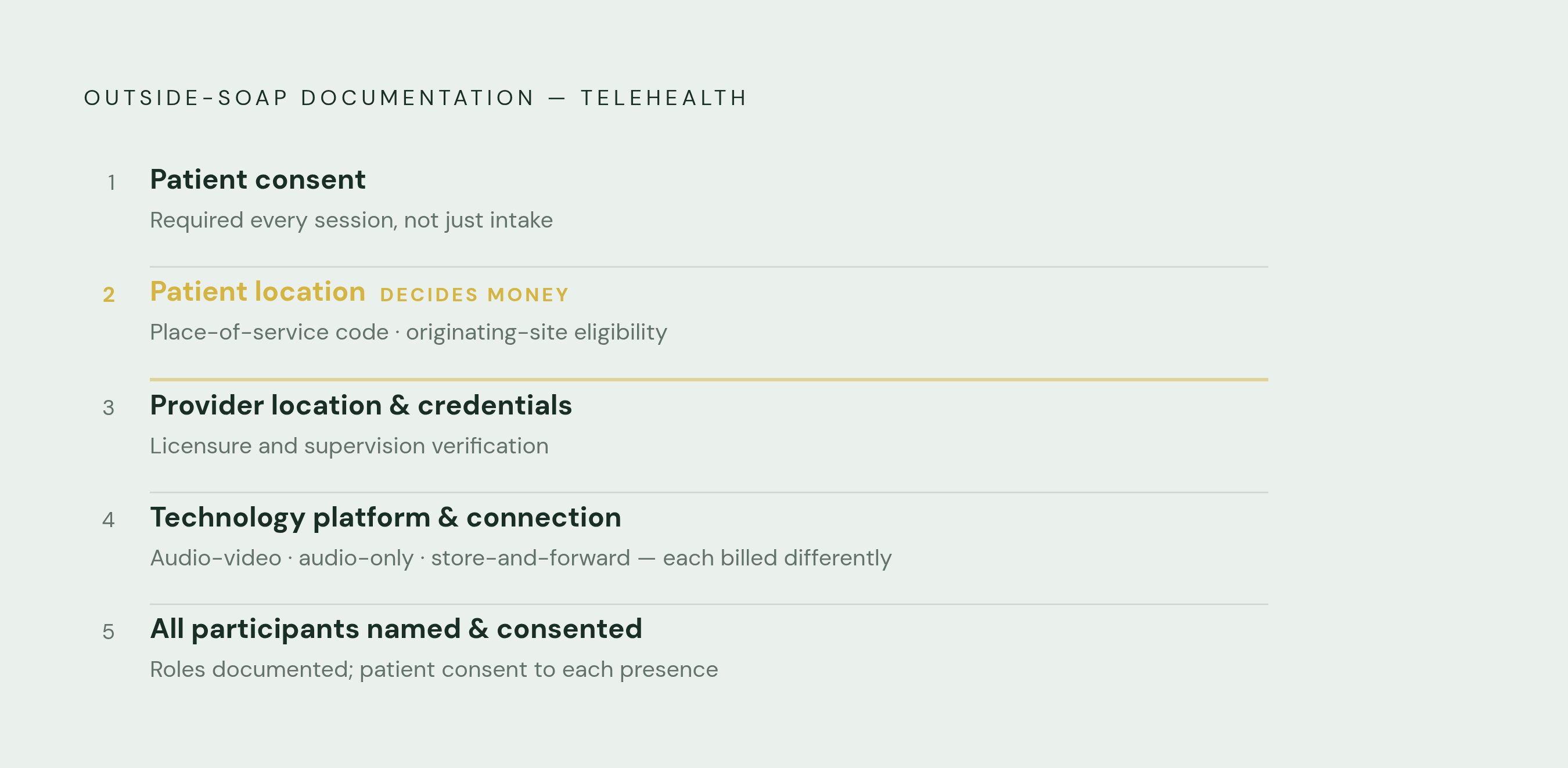
Five things live outside the four SOAP letters, and none of them are optional.
Patient consent comes first. CMS requires it documented before every telehealth session, not just once at intake, and best practice is re-documenting it annually or whenever a new treatment plan starts. The record needs to show the patient actually understood telehealth's benefits and its limitations, not just that a box got checked somewhere by someone in a hurry.
Patient location comes second, and it matters more than it sounds like it should. Home, another clinical facility, a workplace: wherever the patient physically sat during the visit determines the place-of-service code and whether the visit even qualifies under a given payer's originating-site rules. This one detail, easy to skip, decides money.
Provider location and credentials come third, relevant for cross-checking state licensure and, where applicable, supervision requirements.
Fourth: the technology platform and connection quality. Specify whether the visit was audio-video, audio-only, or store-and-forward, since these get billed differently and the note is the only record of which one applied. If the connection had problems, describe them and describe how they were handled.
Fifth: every participant in the session, named, with their role and the patient's consent to having them there. A caregiver on one end, an interpreter on the other, it doesn't matter which; if they were part of the visit, they're part of the record.
How documentation choices drive billing code selection and where mismatches trigger denials
Billing has split into two tracks that don't talk to each other much, and the note is what has to bridge them. Medicare fee-for-service still runs on the standard E/M codes, 99202 through 99215, paired with place-of-service codes and modifiers; it doesn't reimburse most of the newer AMA 98000-series codes. Commercial payers and a lot of state Medicaid programs went the other way and adopted that 98000-98016 series, introduced by the AMA in 2025. The payer decides which track applies, and the clinician usually doesn't know that in advance, so the note has to carry enough detail to support either code path. Getting this wrong is how claims come back unpaid, and that's a documentation burden with no shortcut around it.
The audio-video versus audio-only distinction runs on the same principle. Whether a claim gets modifier -95, for synchronous audio-video, or modifier -93, for audio-only behavioral health, depends entirely on what the note says about the platform and modality used. Worth repeating clearly since people still miss it: the old telephone codes, 99441 through 99443, are permanently gone. Submit a 2026 claim with one of those codes and it gets denied automatically, no exceptions, no appeal that's going to resurrect it.
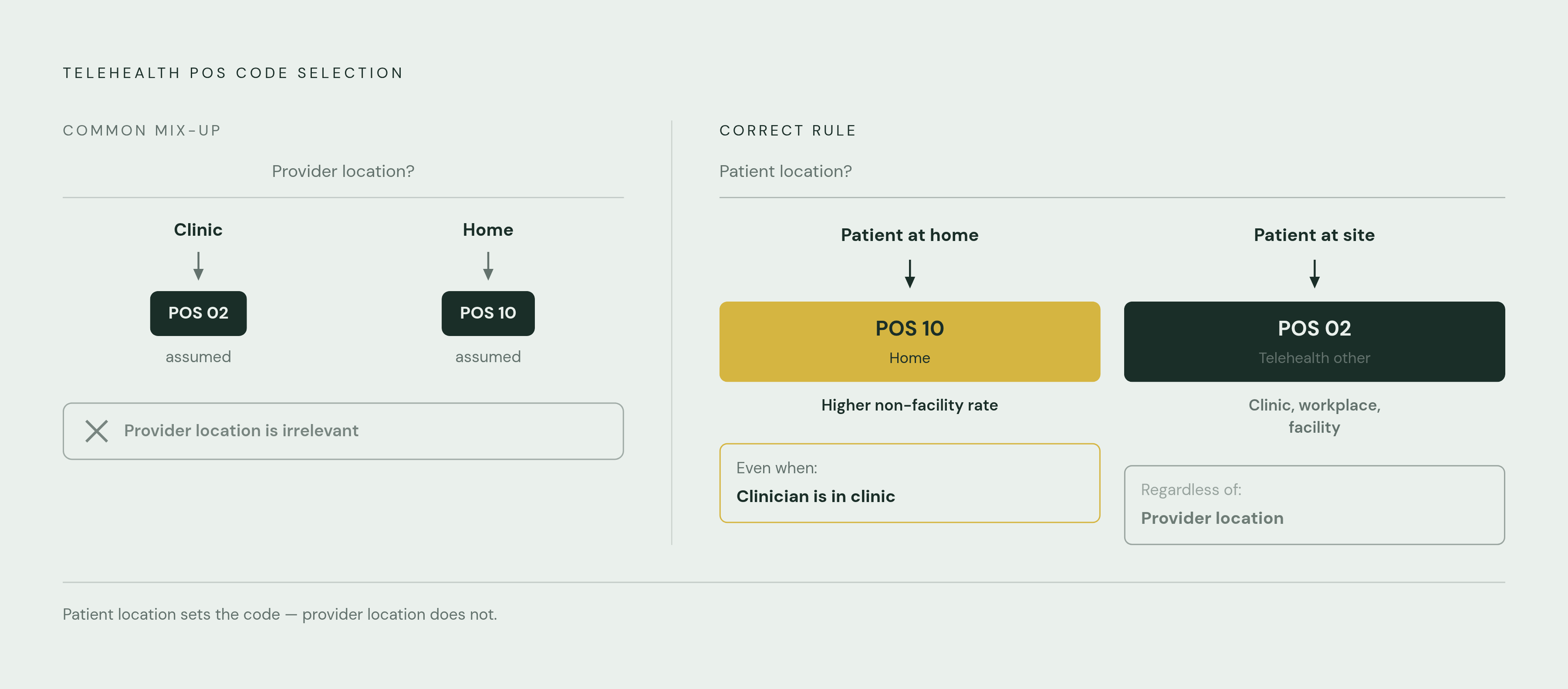
Place-of-service codes trip up more claims than almost anything else on this list, and the mix-up runs backwards more often than anyone would guess. POS 10 means the patient was at home, and it typically pays at the higher non-facility rate. POS 02 means the patient was somewhere else, a clinic, a workplace, another facility. The patient's location controls the code, not the provider's location, and that's the part clinicians get wrong constantly: a clinician sitting in a clinic office bills POS 10 if the patient logged in from their living room. Get that backwards and the claim bounces. This is one of the most avoidable, most common ways telehealth claims get denied, and it has nothing to do with clinical judgment at all, just a box checked wrong.
Time-based billing needs start and stop times written into the note; without them, there's no documented basis for a time-selected code, and the claim has nothing to stand on. Virtual check-ins get their own code now too, CPT 98016, which replaced HCPCS G2012, and it happens to be the one code from the new series that Medicare does reimburse. Document it separately from a full E/M encounter, since it's a shorter, distinct type of visit than a variant of one.
One more figure worth knowing: the originating site facility fee, HCPCS Q3014, pays $31.85 in CY2026, up from $31.01 in CY2025. Small number, but it requires its own documentation showing the patient was physically at a qualifying originating site, so facilities billing it can't skip that detail either.
What the CY2026 regulatory changes mean for documentation going forward
CMS's CY2026 Physician Fee Schedule Final Rule, CMS-1832-F, took effect January 1, 2026, and it changes some of the ground rules underneath all of this. The process for adding services to the Medicare Telehealth Services List got simpler: the old provisional-versus-permanent distinction is gone, and review now just asks whether a service can be delivered through interactive two-way audio-video. Frequency limitations on subsequent inpatient visits, subsequent nursing facility visits, and critical care consultations got permanently removed, which means notes for those encounters no longer need to justify how often the patient was seen. CMS also permanently adopted a definition of direct supervision that allows the supervising physician to use real-time audio-video, though not audio-only, telecommunications; that changes how supervision gets written up in the chart.
Broader Medicare telehealth flexibilities, geographic waivers, audio-only behavioral health billing, FQHC and RHC billing authority, are extended through December 31, 2027. That's a real runway, several years' worth, but it's not a reason to document loosely on the assumption that another extension shows up when this one expires. Document under the rules that exist right now, not the rules someone hopes exist in 2028.
The behavioral health in-person requirement mentioned earlier deserves a second look here because the date matters: starting January 31, 2026, that six-month-then-twelve-month rule becomes an automatic denial trigger if it's not documented, with no flag for manual review first. DEA flexibilities for prescribing controlled substances via telehealth, without a prior in-person exam, run through December 31, 2026; any note involving that kind of prescription needs to show the federal requirements were met.
None of this resolves the Medicare-versus-commercial-payer coding split. If anything, it widens the gap, which means the precision required in every note isn't going away anytime soon. Hoping the reviewer is lenient is not a strategy, and documentation still has to be exact enough to satisfy whichever track ends up reviewing the claim.
A documentation checklist practitioners can apply to every telehealth note before signing
Before signing off, the Subjective section should show the chief concern, history of present illness, relevant history, and every participant named and consented, along with the identity verification method used.
The Objective section needs language that clearly separates video-observed findings from patient-reported ones, an explicit statement of what couldn't be assessed remotely, and, for behavioral health, a full mental status exam written out in the standard systematic format.
The Assessment should include a telehealth appropriateness statement and flag any diagnosis that's provisional because the modality limited what could be confirmed.
The Plan needs the follow-up modality specified, escalation criteria listed, e-prescribing details noted where relevant, and start and stop times recorded if time-based coding is in play.
Outside the four sections: consent documented for this visit, not carried over from a prior one; patient location recorded, since it decides the POS code; provider location and credentials noted; the platform named and the modality specified as audio-video or audio-only; connection quality noted, with any disruptions described. For behavioral health specifically, confirm the in-person visit requirement has been met and documented, or that the session still falls inside the allowable window.
That's the checklist. Run it against the note, section by section, before hitting sign, and it's a lot cheaper than dealing with a denied claim eight weeks later.