Credentialing Requirements for Multi-State Telehealth Providers
Patient location, not provider location.

Multi-state telehealth practice runs on a rule that trips up more organizations than it should: the patient's location controls, not the provider's. Everything else in this piece, the compacts, the registrations, the payer enrollment tracks, the hospital privileging shortcuts, exists downstream of that single fact. Get the location rule wrong and no amount of downstream compliance saves the visit.
Why provider location does not determine which license applies
Medical practice law in nearly every state treats care as rendered where the patient sits at the moment of the visit, not where the clinician happens to be logging in from. A physician licensed in one state conducting a video visit with a patient vacationing in another state is practicing medicine in that other state, full stop, regardless of where the physician's desk, staff, or home-state license live. This reflects a structural feature of how states have defined the practice of medicine for decades: licensure protects the public where the public is, not where the clinician's business happens to be in. It reflects a structural feature of how states have defined the practice of medicine for decades: licensure protects the public where the public is, not where the clinician's business happens to be incorporated or headquartered.
The practical consequence is blunt. A provider holding a single home-state license is out of compliance the instant a patient physically crosses a state line, even if the provider never moves and the patient's "visit" is just a phone screen taken from a hotel room. Neither party needs to relocate an office or a practice for the violation to occur. It's the patient's location at the time of the encounter that matters, not any organizational address on file.
That has a direct documentation consequence. Every telehealth encounter needs the patient's physical location recorded in the chart at the time of the visit, rather than just their mailing address or the address on file from onboarding. It's the evidentiary backbone of the entire credentialing structure that follows. If a state licensing board or a payer ever asks whether a given encounter was legally permitted, the documented location answers the question, forming the evidentiary backbone of the entire credentialing structure that follows.
The Interstate Medical Licensure Compact and its limits in reducing the multi-state licensing burden for physicians
The Interstate Medical Licensure Compact exists to cut down on the sheer repetition of state-by-state applications. A physician holding a full, unrestricted license in their State of Principal License applies once through the IMLC portal and can receive expedited licenses in other member states, without redoing the full application packet for each one. It's a meaningful administrative win for physicians who practice across several state lines, and the compact's membership has kept expanding.
As of mid-2026, the map looks different than it did even a year earlier. Alaska finalized legislation to join on June 26, 2026, becoming the 44th member state and the 46th member jurisdiction overall. Connecticut announced full participation on March 15, 2026. Michigan's membership nearly lapsed: a sunset provision had triggered a withdrawal process scheduled to conclude at the end of March 2026, and only the passage of HB 5455 kept the state in the compact, a renewal that mattered to an estimated several thousand Michigan physicians practicing across state lines.
Eligibility itself is not the bottleneck it once might have seemed. Nearly all applicants who apply are found eligible, and the ineligibility rate has stayed stable at a small minority over the past three years. The compact is designed to let eligible applicants obtain licenses in multiple states through a single application cycle.
None of that changes the compact's most consequential and most misunderstood limitation: compact participation and compact eligibility are two entirely different things. Participation means a state has enacted the compact legislation and it's currently in effect, which is the only condition under which a physician can obtain a license there through the compact pathway. Eligibility means the individual physician meets the compact's criteria, including an unrestricted license in the home state, a clean disciplinary and criminal record, and board certification. A physician can be perfectly eligible and still have no compact pathway into a state that simply hasn't joined. Eligibility is necessary, but it is nowhere close to sufficient.
Interstate compacts for non-physician providers: which are operational
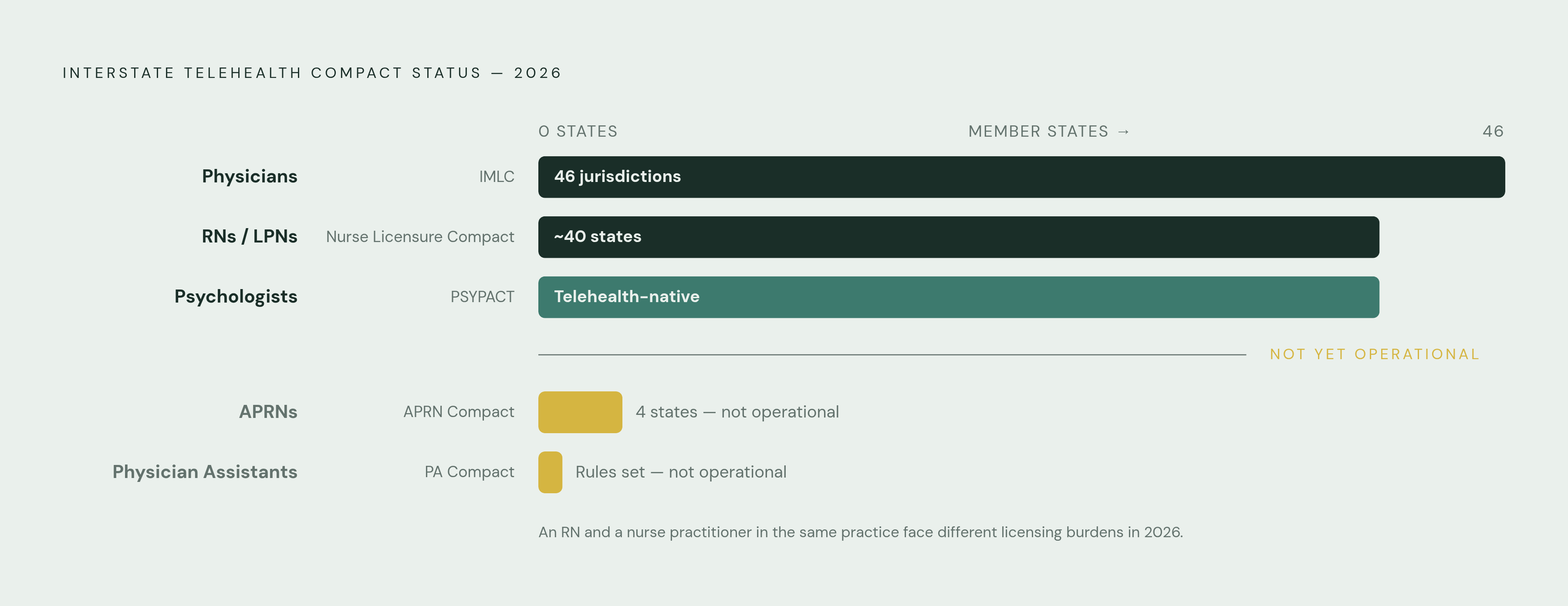
Physicians aren't the only clinicians affected by interstate licensure compacts, but the maturity of these compacts varies enormously by profession, and treating them as interchangeable is a mistake that appears fast in a credentialing audit.
The Nurse Licensure Compact, covering RNs and LPNs, is the most established of the group, with roughly 40 member states now participating. Eligibility under the NLC turns on primary state of residence, not on where an employer or telehealth platform is headquartered, which matters enormously for remote-first nursing staff. The map has kept shifting recently enough to affect current hiring: Connecticut fully implemented the compact on October 1, 2025, and Pennsylvania followed on July 7, 2025. Massachusetts enacted the compact back in November 2024, but as of the most recent information available, implementation there remains incomplete, meaning nurses can't yet rely on it in practice.
Advanced practice registered nurses do not have that same infrastructure. The APRN Compact has been enacted in only four states (Delaware, North Dakota, South Dakota, and Utah) and requires additional enactments to activate. It is not operational in 2026. That creates an odd and often underestimated gap inside the same telehealth organization: an RN colleague may move freely across NLC states under one license, while the nurse practitioner sitting at the next workstation has to license state by state, one application at a time, with none of the compact's efficiency.
Psychologists have it somewhat better. PSYPACT covers telepsychology across its member states and counts as one of the more mature non-physician compacts built specifically with telehealth delivery in mind. It isn't static, though; compact membership carries ongoing costs, not just an upfront application.
Physician assistants sit in a holding pattern. The PA Compact has established rules for how PAs apply for, obtain, renew, and lose compact privileges, and it establishes rules for how PAs apply for, obtain, renew, and lose compact privileges. But as of 2026, it is not yet operational for clinicians to actually use. PAs, like APRNs, are still licensing state by state.
State telehealth registrations as a partial alternative to full licensure
A smaller set of states has built a different kind of pathway entirely: a telehealth-specific registration that lets an out-of-state clinician see in-state patients without going through the full licensure process. Florida, Arizona, Vermont, Colorado, and Delaware are among the states that have created such pathways, though the scope and terms of each vary and should be confirmed with the relevant board. The logic is straightforward: if a clinician already holds a valid license in another state and registers with the relevant board in the patient's state, that clinician can deliver telehealth services within the scope of practice that state's laws define, without duplicating the full licensing application.
These registrations come with real strings attached, though, and none of them function as a full substitute for licensure. In-person practice is generally restricted or limited under these registrations. Practice under these registrations is governed by the scope of practice the patient's state defines. And registration isn't free or one-time: registration requirements vary by state and should be confirmed with the relevant licensing board.
Continuity of care adds another wrinkle that catches practices off guard. When a patient relocates to a new state, a provider generally cannot keep seeing that patient without some form of authorization in the new state, such as a registration, a compact license, or a full license. Some states build in a grace period, typically somewhere between 30 and 90 days, to let the provider hand the patient off to someone properly authorized in the new location. Outside that window, continuing the relationship is a licensure violation no matter how long the provider has treated that particular patient.
Hospital and health-system credentialing for telehealth providers: the privileging layer
Licensure answers whether a provider can practice in a state. It says nothing about whether a hospital, health system, or accredited facility will let that provider deliver care through its telehealth program. That's a separate gate, called credentialing and privileging, and it applies regardless of whether the provider has ever physically entered the building delivering the service.
CMS built a mechanism to keep this from becoming an impossible duplication of effort across every originating site a distant-site provider serves. Credentialing by proxy lets the governing body of a receiving, or "originating-site," hospital rely on credentialing and privileging decisions already made by the distant-site hospital or telemedicine entity. That reliance isn't automatic. It requires a formal written agreement between the two organizations, and the distant site's credentialing process has to conform to CMS's own standards for the arrangement to hold up.
None of this happens by informal understanding between administrators. A hospital's medical staff bylaws need an explicit provision authorizing reliance on the distant site's credentialing decisions, and that provision has to be in place before the telehealth program goes live, not retrofitted after the fact. It's a structural requirement written into governance documents, not an administrative convenience that can be assumed.
There's a genuine efficiency built into more recent Joint Commission guidance, though. Under certain circumstances identified in Joint Commission guidance, a separate round of credentialing solely because the modality is telehealth may not be required. The specific conditions under which this applies should be confirmed against current accreditation standards.
Payer enrollment as a distinct credentialing process that licensure does not satisfy
Licensure is authorization to practice. Payer enrollment is authorization to bill. Conflating the two is one of the more expensive mistakes a growing telehealth practice can make, because a provider can hold every required state license, be fully credentialed and privileged at the hospital level, and still watch every single claim get denied if payer enrollment isn't complete or isn't structured correctly for telehealth delivery.
These are genuinely separate timelines running on separate tracks, and major commercial payers, including UnitedHealthcare, Anthem, Cigna, BCBS, and Aetna, now maintain telehealth-specific enrollment requirements distinct from their standard credentialing packets. That typically means a separate credentialing track built specifically for telemedicine, modality attestations distinguishing synchronous video from audio-only from asynchronous store-and-forward encounters, and documentation that a standard in-person credentialing file simply doesn't include. A practice that submits an in-person credentialing packet and assumes it covers telehealth billing is going to find out otherwise at the claims stage, which is the most expensive possible place to discover a gap.
Medicare adds its own enrollment layer through PECOS. Providers billing Medicare for telehealth services have to be enrolled through that system, and the infrastructure underneath it has recently changed: CMS initiated the cutover of PECOS 2.0 to AWS cloud infrastructure on May 4, 2026, with the full migration expected to continue through the remainder of the year. Providers and their billing teams should expect that kind of infrastructure shift to carry its own transitional friction, even when the underlying enrollment requirements stay the same.
Medicare telehealth coverage rules as of 2026
Medicare telehealth coverage has spent the past several years lurching from one expiration deadline to the next, with the COVID-era flexibilities lapsing twice before lawmakers stepped back in. H.R. 7148, signed February 3, 2026, extended those flexibilities through December 31, 2027, giving telehealth practices the longest runway of policy certainty they've had since the pandemic-era rules first took effect.
The provisions preserved through that date matter concretely. Medicare telehealth coverage flexibilities extended through the end of 2027 include provisions affecting where patients can receive services and which originating sites qualify. Certain provider types and facility categories also retain coverage under the extended flexibilities. And audio-only telehealth visits, for services outside the behavioral and mental health categories, remain covered, which matters enormously for patient populations without reliable video access.
CMS made one of these changes permanent rather than temporary. The latest annual payment rule from the federal health program's physician payment update removed frequency limits entirely on subsequent inpatient and nursing facility visits, along with critical care delivered via telehealth. That's a durable policy shift, immune to another expiration cliff.
What's still unresolved is administrative rather than substantive. CMS is required to create new telehealth billing modifiers by January 1, 2027, and practices along with their credentialing and billing teams should plan for additional administrative requirements to land before that deadline. The coverage policy itself has stability through 2027; the billing mechanics implementing it do not yet.
Credentialing must start before a practice is ready to launch
Every layer described above, compact licensure, telehealth registration, hospital privileging, payer enrollment, runs on its own timeline, and none of those timelines move at the speed of a launch date set by a business plan. Payer enrollment in particular tends to run long, often taking weeks to months depending on the payer and the cleanliness of the application on first submission. Credentialing by proxy agreements require negotiated legal language between institutions before a single telehealth encounter can count as covered. Compact licenses, however expedited relative to a from-scratch application, still require processing time on the receiving state's end.
The organizations that get multi-state telehealth right treat credentialing as the long pole in the tent, not an afterthought handled after clinical staff are hired and scheduling software is configured. Starting payer enrollment only once a provider is fully licensed and ready to see patients guarantees a gap between clinical readiness and billing readiness, a gap that appears in either unpaid care or care that has to be turned away. The licensure layer, the compact layer, the registration layer, and the payer layer all have to be moving in parallel, well before the date anyone intends to see a first patient across a state line.
Sources
- State Telehealth Policies for Cross-State Licensing - CCHP
- Credentialing for Telehealth in 2026: State Rules, Cross-State Practice, and What Most Practices Get Wrong
- Telehealth Licensing Requirements by State: 50-State Reference Guide (2026)
- Telemedicine Credentialing 2026: Complete Guide for Providers
- rehmann.com
- apta.org
- Telehealth Licensure 2025–2026: Cross-State Practice | Telehealth.org
- Licensing across state lines | Telehealth.HHS.gov