The Clinical Note EHR and Scheduling Tools
Bulk Messaging and Broadcast Tools in Telehealth EHR Platforms
- Published
- November 22, 2026
- Reading time
- 8 min read
Summary
Live EHR data, consent, and replies decide which broadcast tool works.
Bulk messaging and broadcast tools in telehealth EHR platforms are most valuable when they act on live patient data, with exported lists offering less value. Their usefulness depends on how closely outreach connects to the patient record, consent, and the work that follows a reply. Evaluating these tools therefore requires more than comparing send volumes or channel counts. It requires understanding how messaging fits into care delivery.
Why broadcast messaging moved from optional add-on to core EHR capability
As telehealth grew, staff struggled to keep up with calls to patients. Appointment reminders, recall campaigns, and service updates competed for staff time, while no-shows and call center overload added pressure. A single-action bulk send addressed the repetitive outbound work that contributed to staff burnout. Broadcast became part of the communication infrastructure.
Text messaging strengthened the case for this shift because SMS open rates are substantially higher than those of email or patient portal messages. Reaching patients through a channel they are more likely to open gives practices a practical reason to move beyond phone-only outreach. But reach alone does not make a message appropriate. A reminder based on yesterday’s appointment list can already be wrong.
That distinction separates an embedded capability from an added send tool. Broadcast tools connected to current EHR data can exclude a patient who rescheduled yesterday from tomorrow’s reminder without a manual list refresh. Exported lists cannot reflect that change on their own.
What bulk messaging tools inside a telehealth EHR actually do
Broadcast messaging spans one-to-many outreach, two-way response handling, and automated follow-up. These functions form a connected capability layer. A clinic can send weather closures, service updates, public health campaigns, or recall notifications to a filtered patient segment in one staff action. Patients can then reply, and automation can extend the initial message into a sequence, saving another manual send.
A mammography recall campaign makes these functions concrete. A care team selects patients with an overdue care gap and sends the relevant outreach to that segment. Replies become conversations that front-desk staff must triage, while trigger-based follow-up can continue the campaign for patients who have not responded.
Channel scope includes SMS, MMS, email, IVR, and secure portal messaging. Platforms with cross-channel routing can deliver a campaign through the channel each patient has consented to and prefers. That distinguishes a communication platform from a single-channel messaging app. A unified inbox, automation, and EHR synchronization keep the context of a conversation as it moves between channels, while a stand-alone send tool loses that thread.
How EHR integration determines what a bulk send can actually do
Integration depth governs data freshness, segmentation precision, and audit completeness. A live connection through an API, FHIR, or HL7v2 can query the record at send time, while a CSV export is a snapshot that ages as soon as it leaves the EHR. Current filters for appointment type, care gap status, provider, location, or diagnosis depend on live access to the relevant scheduling and clinical data.
Read access is only half the connection. Bi-directional synchronization writes patient replies, opt-outs, and confirmed appointments back to the EHR so the record stays up to date and staff are less likely to contact the same patient twice. With native integration, message events are also logged in the patient record without staff having to enter them. A disconnected tool instead produces an external log that staff must reconcile.
The connection method also affects organizational fit. HL7v2 supports legacy ADT and scheduling feeds, FHIR R4 supports modern interoperability, and direct API connectors provide another route into the EHR. Platforms supporting all three can serve multi-EHR environments after health system acquisitions. However, deeper integration creates dependence on the connector and the workflows built around it. Changing EHR vendors can cause significant disruption, and support for open standards such as FHIR and HL7v2 reduces that risk while leaving some exposure.
The compliance layer every broadcast send operates inside
Integration makes outreach precise, but it does not establish permission to send. Healthcare broadcast must meet rules for data security, carrier delivery, and patient consent. Each addresses a different failure mode. Even when a campaign is technically correct, it can expose protected information, fail to reach patients, or ignore an opt-out.
HIPAA sets the rules for data security when messages contain Protected Health Information (PHI). Standard consumer and business texting tools are not built to handle clinical information such as lab results, prescriptions, or clinical updates. A business associate agreement (BAA) and compliant infrastructure provide the foundation, but configuration and staff use also determine compliance. For messages labeled “healthcare texting,” the content sets the requirement.
A2P 10DLC governs a separate delivery boundary. Platforms that manage registration for healthcare customers remove a deployment step. That service does not replace HIPAA safeguards or consent management.
TCPA rules establish the consent layer, including the requirement effective April 11, 2025, to honor revocation through any reasonable method, including keyword replies such as STOP. The FCC adopted a Report and Order on September 30, 2026, revising consent-revocation rules. The narrower rule took effect November 25, 2026, superseding the blanket “revoke-all” provision and its previously delayed January 31, 2027 effective date. Consent therefore needs records that show which channel and message type each patient has given permission to use.
How the leading platforms distribute these capabilities in practice
Artera provides an enterprise patient communication layer covering text, email, IVR, and webchat. Its real-time EHR connections use API, FHIR, and HL7v2, making it suited to heterogeneous systems brought together through health system acquisitions. Its Staff AI Co-Pilot supports message creation within the messaging workflow. Its custom pricing fits its focus on large organizations with more than one site.
Emitrr combines two-way SMS, mass texting, missed-call text back, appointment reminders, and AI auto-replies with smart routing. Its integrations span EHR/EMR, PMS, VoIP, and CRM systems, connecting patient communication with several operational systems. Emitrr’s product page also says it offers AI call answering. It is aimed at clinics that want AI-powered communication without paying enterprise-scale prices.
TigerConnect has a different center of gravity. It focuses on internal care-team coordination rather than patient-facing broadcast, with role-based communication that helps staff find the appropriate clinician and patient-context messaging that attaches EHR references to conversations. Its custom pricing targets large hospital networks.
OhMD offers broadcast messaging, live HIPAA-compliant website chat, automated appointment reminders, and two-way patient communication across a broad range of EHR connections. Its accessible pricing suits smaller practices, though integration depth can be narrower than in enterprise platforms. QliqSOFT combines secure messaging, telehealth, patient engagement, and workflow automation. Positioned for large practices with custom pricing, it supports targeted mass updates about schedule changes, health alerts, or new services.
TXTImpact provides mass texting and automation with HIPAA compliance built in. Its channels include SMS, MMS, RCS, and WhatsApp, with shortcode sender options, while EHR integration connects messaging to real-time patient records. Recall notifications, two-way texting, SMS surveys, email-to-text, and AI-powered message creation broaden its outreach functions. Its accessible starting point makes it an option for clinics through to hospitals.
Spruce Health puts chat with teams and patients in one place. Its per-user pricing and focus on collaboration and one-to-one patient conversations suit small practices. That profile differs from an enterprise communication layer without making it a lesser choice. Across these platforms, fit depends on what the clinic needs to communicate and the EHR connection required to support that communication.
What workflow integration looks like when broadcast tools connect to scheduling, intake, and billing
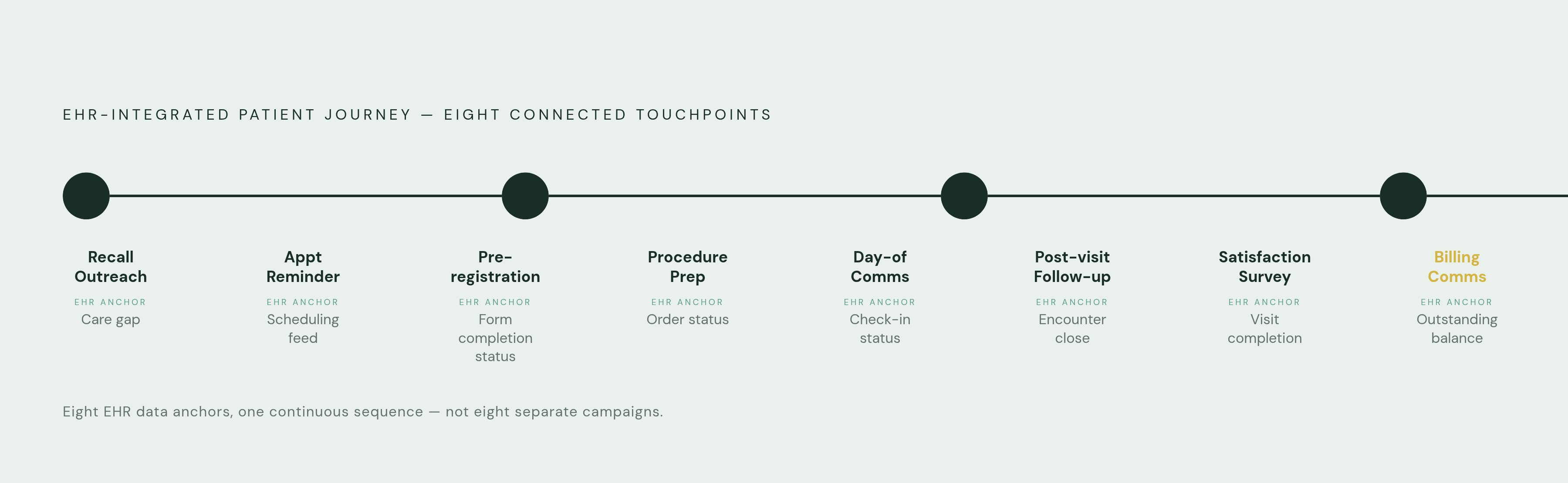
A mammography recall becomes a workflow when each message responds to the patient’s current stage. The care gap starts the outreach, the scheduling feed supplies data for appointment reminders, and whether forms are complete guides pre-registration and intake messages. Procedure preparation can connect to order status, while day-of communication connects to check-in. Each transition has a distinct data anchor.
After the visit, encounter close can trigger follow-up, and visit completion can support a patient satisfaction survey. Billing communication adds a further touchpoint based on an outstanding balance. Treating them as disconnected campaigns forfeits the continuity that integration provides.
Automation connects those stages without repeated manual sends. Conditional workflows can escalate to a phone call when no confirmation arrives within a set window, while multi-step sequences support continued follow-up. No-code builders allow operational and clinical teams to configure those paths without engineering support. This lets smaller telehealth practices set up those paths even if they have no technical staff.
Large broadcasts reduce outbound calls but generate inbound reply threads requiring triage. A practice preparing a high-volume campaign should establish that inbound workflow before launching it.
Where bulk broadcast falls short and what to combine it with
Broadcast reaches a population efficiently, but reach does not equal individualized support. Patients at the highest risk often need outreach that takes account of circumstances a generic template cannot cover. Non-attendance can reflect forgetfulness or competing demands on time and resources. It can also reflect poor engagement or inaccessible scheduling, which a reminder alone does not resolve.
Live EHR fields narrow the personalization gap. Messages can use a patient’s name, provider name, appointment type, or specific care gap along with static text. AI capabilities can further adapt outreach by routing messages according to patient context, escalating unacknowledged messages, or generating personalized variants.
Channel choice creates another limit on reach. Patients with barriers to access, lower health literacy, or limited digital engagement may be poorly served by text-only campaigns despite needing proactive outreach. A complete strategy therefore combines automated broadcast with phone follow-up for non-responders.
How to evaluate broadcast and bulk messaging tools for a telehealth EHR environment
Evaluation begins by asking whether the tool operates from live patient data or requires manual list management. That question leads directly to the specific EHR connection, supported version, and use of FHIR, HL7v2, or a direct API. Write-back deserves equal attention to read access. Opt-outs and confirmed appointments need to return to the record if the communication workflow is to remain synchronized.
Evaluation should cover a signed BAA, AES-256 and TLS 1.3 encryption, audit logs, role-based access, A2P 10DLC registration support, and consent-revocation workflows aligned with the revised rule. None substitutes for the others or for appropriate configuration and use.
SMS-first outreach makes sense for many populations, while practices serving older or less digitally engaged patients should confirm IVR or voice fallback for non-responders. Platforms with deeper workflows can run no-code conditional sequences across the patient journey, while those with limited workflows offer only single-step reminders. Inbound routing also needs a close check because staff must triage replies by hand when there is no routing logic.
Per-seat pricing makes cost scale predictably with staff numbers but may cap message volume, while platform-fee-plus-usage pricing keeps team size outside the cost equation and suits high-volume broadcast. Overage terms need clarification before commitment. The final choice should match integration depth, outreach scope, and organizational scale to the practice’s EHR environment, rather than defaulting to the largest platform or the lowest starting price.
How to cite
Theo Okonkwo. Bulk Messaging and Broadcast Tools in Telehealth EHR Platforms. The Clinical Note. November 22, 2026. theclinicalnote.com/posts/bulk-messaging-and-broadcast-tools-in-telehealth-ehr-platforms
© 2026 The Clinical Note