The Clinical Note Administrative Workflow
Appointment Reminder Systems and Patient Communication Compliance
- Published
- October 10, 2026
- Reading time
- 11 min read
Summary
Reminder systems alone cannot solve rising no-show rates.
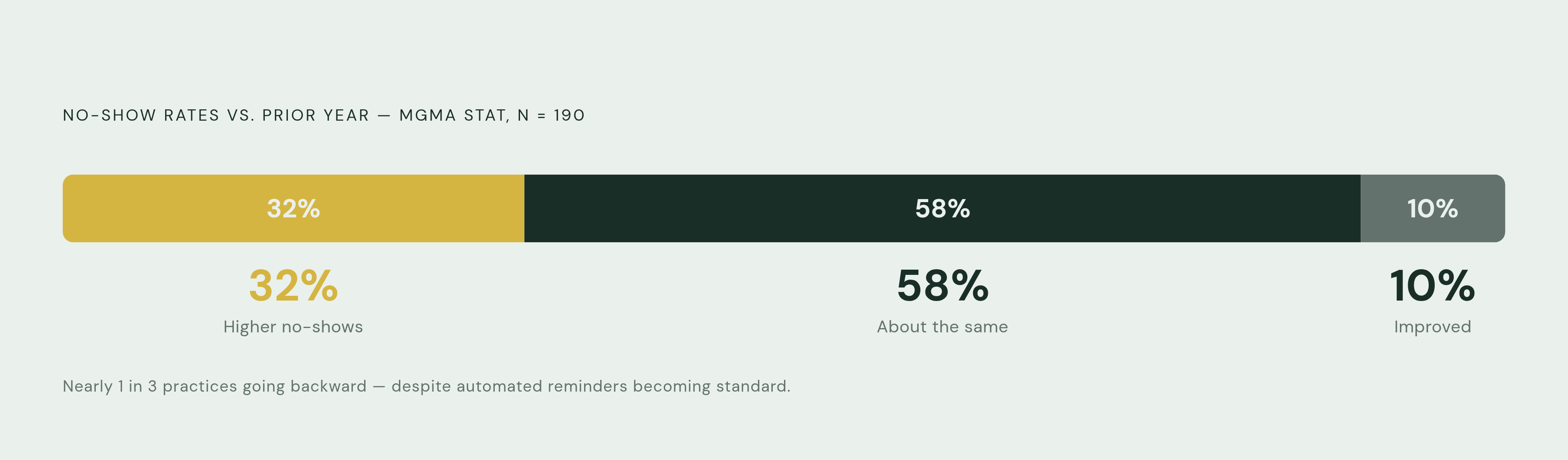
Appointment reminder software has never been easier to buy or deploy, yet the no-show problem is getting worse anyway. An MGMA Stat poll drawing on 190 responses found that 32% of medical groups reported higher patient no-show rates compared with 2025, while 58% reported rates about the same and only 10% reported improvement. Nearly four in ten medical groups have watched their no-show rates climb even as automated reminders became standard practice across the industry. The tools themselves are not the limiting factor anymore. The cost of that gap is not abstract. Missed appointments drain billions of dollars a year from the U.S. healthcare system, and every empty slot represents real revenue a practice cannot recover once the appointment time passes. The damage runs past the balance sheet too: a no-show wastes the staff time spent preparing a chart, leaves a scheduling hole too late to fill, raises the fixed cost of every visit that does happen, and pushes other waiting patients further back in line. Worse, a missed follow-up often means a chronic condition goes unchecked for another month, a medication adjustment gets delayed, and the patient eventually shows up in an emergency room instead, a more expensive outcome for the system and a worse one for the patient. The rest of this piece works through why reminder systems have stalled out at a single-channel plateau and what separates a practice that keeps lowering its no-show rate from one that has leveled off despite doing "everything right."
Why patients miss appointments
Forgetting is the most common reason patients miss appointments, and it is the reason reminders work. That is a fortunate overlap, because forgetting is the one cause a well-timed message can solve almost completely. The longer the stretch between booking and the appointment date, the more time a patient has to forget the date, run into a scheduling conflict, or simply lose the motivation that got them to book in the first place, which makes reminders especially valuable for anything scheduled weeks out.
But forgetting is only one branch of the problem. Patients also skip appointments out of fear, whether of a diagnosis, a procedure, or a bill they cannot afford. They skip because they lack a ride or cannot get out of work. They skip because a prior visit involved a two-hour wait and they no longer trust that this one will go faster. None of those causes respond to a text message, no matter how well it is timed. A reminder cannot shorten a six-week wait for a specialist, cannot make rescheduling simple if the portal is clunky, and cannot talk a patient out of dread before a biopsy. The honest accounting is that reminders fix forgetting almost entirely and leave the rest of the problem exactly where it was.
A patient who can no longer make an appointment but receives only a one-way reminder with no way to respond tends to go quiet. The message delivers, nothing happens, and the slot dies unfilled. The practice loses both the visit and any chance to give that slot to someone else waiting for one.
The useful move for a practice is to treat its no-show rate as a pattern to diagnose. No-shows that cluster around new patient visits point to a different cause than no-shows that cluster around prep-heavy procedures, long-booked follow-ups, a specific provider, or a particular neighborhood. Pulling outreach data by appointment type, provider, day and time, lead time, payer, and geography tells a practice which cause is actually driving its rate, and that answer determines where the next dollar of investment should go.
How channel choice shapes reminder delivery
Channel is not a setting a practice picks once and forgets; it decides whether a reminder lands. Text messages get opened at rates far above email, and most arrive and get read within minutes, so an SMS reminder reliably reaches a patient's attention in a way email often does not. Email open rates run a fraction of what SMS achieves. A reminder program built on email alone is, for a meaningful share of patients, functionally the same as sending no reminder.
The clinical evidence backs the pattern. A randomized controlled trial published in the International Journal of Pediatrics in 2016 found that adding text message reminders cut the no-show rate substantially against a control group, a result that lines up with the direction of larger reviews on the subject. A 2025 quality improvement project at an outpatient mental health clinic found that sending text reminders before appointments produced a statistically significant drop in no-shows comparing the periods before and after the change went in.
None of that makes SMS a universal fix. A workflow built entirely around text messages will miss an older patient who answers the phone but ignores texts, and it will miss a rural patient whose mobile number on file is three years out of date. Channel mismatch like this is a real operational failure, not a minor inefficiency, and the practices that hold their no-show rates down tend to combine text, email, live-call escalation, and voice rather than defaulting to one channel for every patient on the schedule.
There is a genuine equity wrinkle here too. Cell phone ownership, and use of a phone for health information specifically, runs higher among Latino and Black Americans than among white Americans, so SMS has real reach into communities that other channels miss. That reach does not automatically turn into engagement on its own. Getting a message in front of a patient and getting that patient to act on it are two different design problems, and the next two sections are about closing that second gap.
Why timing and sequencing of reminders matter
Getting the channel right solves nothing if the timing is wrong. A single reminder, fired too early or too late, consistently underperforms a short sequence of reminders, because each message in that sequence does a different job depending on where the patient is in the decision window.
A message sent right at booking locks in the date, time, location, provider, and a path to reschedule while the patient's attention is already on the appointment, and research on pre-visit commitment suggests patients who engage at that moment are more likely to show up later. A reminder sent a few days out catches the patient who booked weeks earlier and has since moved on mentally, and it re-surfaces a date that had drifted out of view. A reminder sent the day before or the same day catches whatever conflict has emerged since booking, a shift change, a car that will not start, a kid home sick from school, and this is the point in the sequence where a two-way channel matters most, because the patient still has time to reschedule. Digital intake sent ahead of the visit does similar work from a different angle: asking a patient to spend a few minutes filling out forms in advance raises the odds that patient follows through, and the practice gets completed paperwork out of it regardless of how the visit goes.
The gap between booking and the appointment date is one of the strongest predictors of no-show risk that a practice can measure, and a longer gap calls for a longer, more active sequence of touches. Practices that track outreach results by lead time, not only by specialty or provider, can find the exact point in the booking window where their current sequence stops working and adjust from there. Timing, in other words, is a decision a practice makes deliberately for each segment of its schedule, not a default the reminder software ships with.
Two-way reminders as a managed schedule
Everything up to this point describes how to get a message in front of a patient at the right moment through the right channel. None of it addresses what happens after the patient reads it. That is where the real split between practices happens: a reminder that lets a patient confirm, cancel, or reschedule inside the same interaction does fundamentally different work than one that only announces a date, and the gap in results between the two is well documented.
Two-way reminders that let a patient confirm or cancel directly raise confirmation rates substantially compared with one-way messages, because the patient who can no longer make it has an immediate, low-friction way to say so, which preserves the slot for someone else. A phone call outperforms a text blast in the research because it is a conversation: a caller can answer a question about insurance, move the appointment to a different day, or take the cancellation and get the slot back on the board, all inside one call. A one-way blast cannot do any of that. The patient who was already on the fence ignores it, the message technically delivers, and nothing happens, no action, no slot recovered.
A cancellation captured through a two-way reminder should trigger outreach to a waitlist automatically, turning the cancellation into an opening for whoever is next in line. Luma Health builds its system around exactly this mechanic: when a patient cancels, the platform sends automated outreach to the next patient waiting for an earlier opening, matched by appointment type, duration, and provider, pairing AI-driven reminders with that waitlist backfill. Artera, formerly WELL Health, approaches the same problem from the health system level, centralizing messaging across departments, and as of 2026 offers an AI Services Model whose AI Service Squads build custom agentic solutions for specialty care groups and federally qualified health centers. Curogram reports that Atlas Medical Center cut its no-show rate sharply within three months after adopting automated, two-way reminders alongside other changes, an outcome that illustrates how much these design choices compound once a practice stops treating reminders as a one-way broadcast.
The distinction between a one-way and a two-way reminder explains why some practices keep improving their no-show rate year over year while others plateau after the first round of automation. The plateau belongs to the practice still treating the reminder as a notification. The improvement belongs to the one that treats it as the front door to a managed schedule.
AI voice agents as a qualitative shift beyond automated reminders
AI voice agents are not simply a faster way to send the same reminder. They resolve the limitation that has capped both text blasts and human phone calls for years: a blast can reach everyone but can't talk, and a human caller can talk but can't reach everyone. An AI voice agent holds an actual two-way conversation, verifies who it's speaking with, reschedules the appointment inside that same call, and writes the outcome straight to the EHR, closing out the slot in one pass instead of routing it to a staff member's call list for the next morning.
Paying a person to call every patient on the schedule never scaled past a certain practice size, and that is why most practices settled for one-way blasts: the economics of hiring enough staff to call everyone didn't work. Conversational AI removes that ceiling by delivering something close to a human phone conversation for every appointment on the book, at any hour a patient happens to be free to answer.
That capability deserves a real caveat. A 2025 peer-reviewed qualitative study looked at how acceptable AI machine learning-driven outpatient appointment management was to staff and patients at a single NHS site in central England. The broader mixed-methods trial that study was part of found that using the AI technology did not produce a detectable improvement in Did Not Attend rates across three specialties in two NHS Trusts. That result cuts against vendor claims about predictive targeting, and it says something important: installing an AI system is not the same as deploying it well. The honest position is that AI voice raises the ceiling on what a reminder system can accomplish inside a single call, but it does not remove the floor of no-shows driven by fear, cost, transportation, and everything else no software touches. Whether the technology delivers depends on how carefully it is designed and rolled out, not on the fact of having bought it. An MGMA Stat poll found that only about 19% of medical group practices currently use any version of a chatbot or virtual assistant for patient communication, with 81% still not using one; the industry is still early in finding out which deployments actually work.
The regulatory framework practices must navigate alongside reminder design
Every choice described above, channel, timing, two-way design, AI voice, runs through a legal filter that operates independently of whether the reminder system works well operationally. HIPAA and the TCPA both apply to automated patient reminders, and they are not substitutes for each other: satisfying one says nothing about whether a practice has satisfied the other.
HIPAA governs what a reminder can contain and how the patient data behind it must be protected. A text message carrying an appointment date, a provider's name, or a procedure type is a communication of protected health information, and it has to be handled with that status in mind from the moment it is drafted to the moment it is delivered. The TCPA runs on a separate track entirely, covering automated calls and texts and the consent required before a practice can send them. A practice that rolls out an auto-dialer for SMS reminders or an AI voice calling program without documented patient consent on file carries TCPA exposure no matter how solid its HIPAA safeguards are elsewhere, because the two frameworks are independent and both have to be satisfied at once.
AI voice makes this more complicated, not less. The very feature that makes an AI call effective, that it runs automatically and can reach every patient on the schedule without a staff member dialing each number, is the same capability the TCPA was written to regulate. A practice scaling up AI-driven outreach is scaling up exactly the kind of automated contact that draws the closest legal scrutiny.
The practical upshot is that channel selection, message timing, and consent tracking are not purely operational decisions a scheduling team makes on its own. They are legal decisions with consequences, and a reminder system built without a compliance layer is carrying risk that has not yet come due. Pre-visit digital intake adds one more layer to keep straight: once a practice is collecting patient data digitally before the visit itself, the obligations around consent and data handling extend past the reminder message and into whatever form or portal the patient is filling out next.
References
- About 1 in 3 medical groups see higher no-shows in 2026 as patients face higher costs Provided the MGMA Stat poll data showing 32% of medical groups reported higher no-show rates in 2026, based on 190 responses.
- Frontiers Provided the peer-reviewed qualitative study on staff and patient acceptability of AI appointment management at an NHS site and the finding that AI did not produce detectable improvement in Did Not Attend rates.
- 585 A Quality Improvement Project to Impact Adult and Pediatric No-Show Rates Provided the 2025 quality improvement project finding that SMS reminders produced a statistically significant drop in no-show rates at an outpatient mental health clinic.
How to cite
Theo Okonkwo. Appointment Reminder Systems and Patient Communication Compliance. The Clinical Note. October 10, 2026. theclinicalnote.com/posts/appointment-reminder-systems-and-patient-communication-compliance
© 2026 The Clinical Note