EHR Workflow Automation for Integrative Health Clinics
Integrative practices need EHRs built for their complexity, not general systems forced to fit.

A single integrative medicine visit routinely produces four separate billing and documentation streams that no off-the-shelf EHR was built to handle together. That mismatch, not any missing feature, is why so many IM practices end up running two or three disconnected systems just to get through a normal day. The fix requires fewer, better-integrated systems rather than more software bolted onto the pile. It's picking the one system built around how IM actually works, and knowing which gaps automation can't paper over.
The five capability gaps that determine whether an EHR actually fits an IM practice
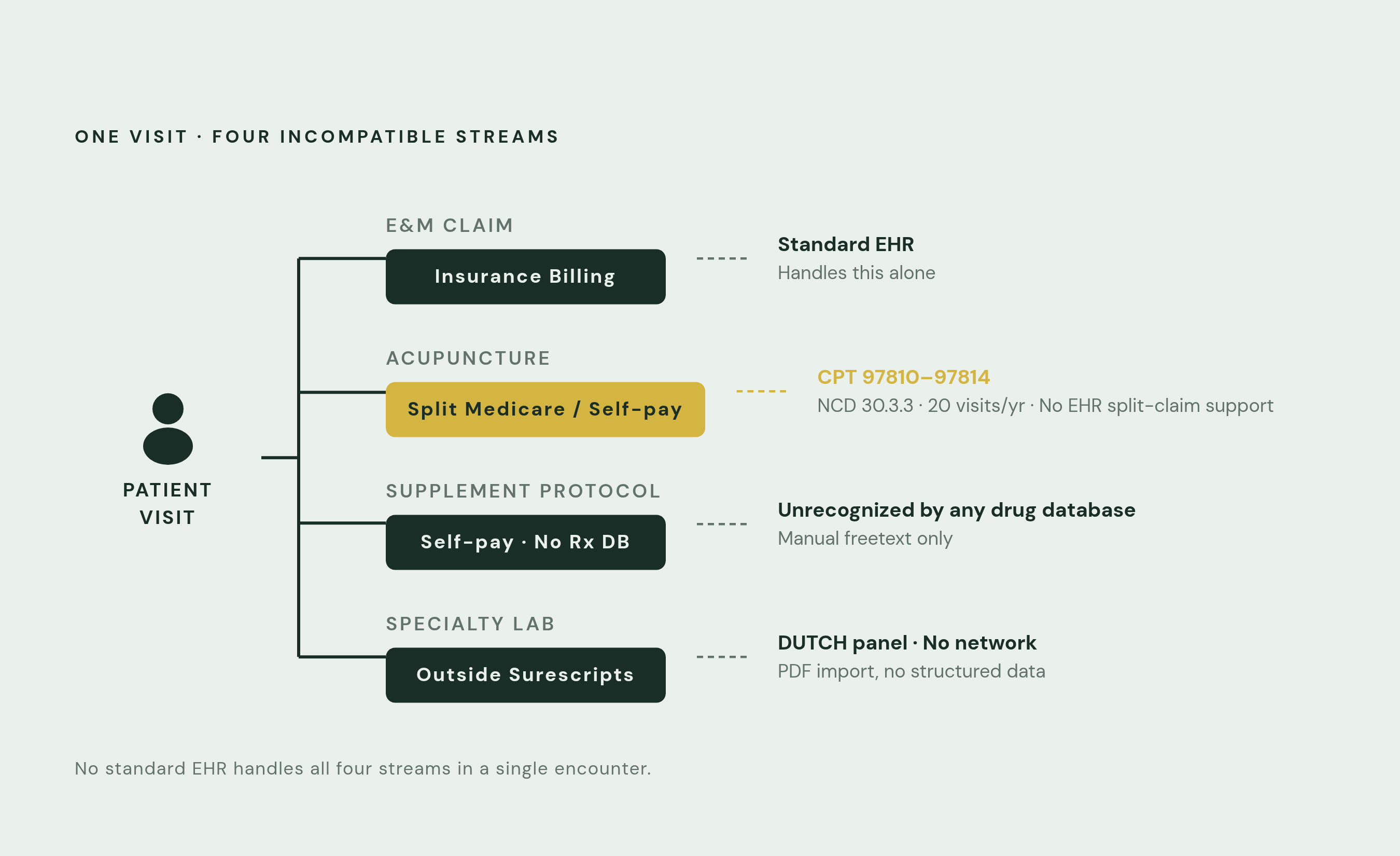
Take one patient, one visit. She comes in for an E&M encounter billed to insurance the usual way. Then she gets acupuncture, which under CMS's 2020 expansion of Medicare coverage for chronic low back pain (CPT codes 97810 through 97814, up to 12 visits in 90 days, 8 more allowed if the notes show improvement, capped at 20 visits a year under NCD 30.3.3) has to be billed as a split Medicare and self-pay claim. She leaves with a supplement protocol that doesn't exist in any drug database the EHR recognizes. And her workup includes a DUTCH hormone panel from a specialty lab the system has never heard of. Four workflows, one visit, and not one mainstream EHR handles all four without some kind of manual patch job.
Ask any vendor for a live demo using a practice's real workflow, not a canned one, and the gaps show up fast. Five of them decide whether a system actually works for integrative medicine or just looks like it might.
Multi-modality billing comes first, the one most practices underestimate until it costs them an afternoon. A practice billing Medicare and self-pay in the same visit needs split-billing built in, not bolted on. Without it, front-desk staff manually split claims across three payment types on a single patient account, and that's exactly the kind of task that eats time and invites errors.
Supplement and nutraceutical protocol tracking is the second gap, and the strangest one, since no major EHR vendor has actually built a database for it. Practitioners either stuff dosing information into a free-text drug field that then throws up irrelevant drug-interaction alerts, or they keep a spreadsheet that has nothing to do with the EHR at all. Fullscript's dispensing integration has become the default fix for practices that dispense supplements directly. (Wellevate, once a competitor there, was acquired by Fullscript and subsequently shut down.)
Functional lab ordering and tracking is the third gap. Specialty panels from labs like DUTCH, Genova, or Vibrant America need to sit next to a standard CBC in the same chart, not live as a PDF buried in a documents tab. FHIR-based exchange is what makes that possible for labs outside the standard Surescripts network, and regulation is pushing vendors toward it: the CMS Interoperability and Prior Authorization Final Rule (CMS-0057-F, finalized January 2024) requires FHIR-based APIs for prior authorization, patient access, and provider data exchange, with operational provisions starting January 1, 2026 and full implementation deadlines beginning January 1, 2027.
IM-specific documentation templates make up the fourth gap. Acupuncture point charting with meridian notation, herbal formula documentation, 60 to 90 minute functional intake forms, mind-body SOAP notes, lifestyle medicine protocols: none of this comes from tweaking a standard physician SOAP template. These are different clinical languages, and a system that can't speak them natively forces practitioners into workaround documentation that rarely holds up for billing or continuity of care.
Multi-practitioner scheduling with modality differentiation rounds out the list. An ND, an LAc, an MD, an RDN, a massage therapist, and a health coach might all book off the same calendar, each with different appointment lengths, different room needs, different billing codes, and shared equipment that can't double-book. Generic scheduling tools treat every practitioner as interchangeable. That's just not true in an IM practice, and pretending otherwise is how double-bookings happen.
These five aren't preferences on a wish list. They reflect how nonlinear and multi-sourced integrative care actually is, a structure that exceeds what general-purpose platforms were designed to accommodate.
How the main IM-relevant platforms stack up against those five gaps
No single platform clears all five gaps cleanly, and any vendor who claims otherwise hasn't looked closely at your billing mix. Choosing one is a tradeoff exercise, shaped by how complex the practice's clinical work is, how big it is, and what it can spend.
Cerbo was built specifically for integrative and functional medicine, and it shows in the details most competitors skip. It integrates natively with Genova, Vibrant, Diagnostic Solutions, Precision Analytical (which includes DUTCH), Doctors Data, and Mosaic Diagnostics, so lab results land as structured data inside the clinical workflow instead of as scanned PDFs. It also covers supplement tracking and automated workflows with a depth few competitors match. Paula Tomczyk, Clinic Manager at Cara Direct Care, put the stakes this way: choosing the right system from day one matters because it's a long-term investment that shapes the practice's efficiency for years.
OptiMantra covers a similar range of disciplines: functional medicine, naturopathy, acupuncture, chiropractic. It handles telehealth, online scheduling, automated reminders, a patient portal with secure messaging, e-signatures, lab sharing, and supplement inventory, along with billing that spans memberships, packages, and insurance claims.
Jane App is probably the strongest off-the-shelf option for scheduling across practitioners, and it works best for clinics up to around 20 providers, whether they bill insurance, run self-pay, or mix both. It handles online booking, customizable intake forms, and multiple appointment types well. But it isn't a medical-grade EHR, and treating it like one is a mistake. It lacks the lab handling and clinical tooling functional medicine actually requires, so think of it as a scheduling and payments layer, not a full clinical system.
Practice Better fits nutrition-focused practices, health coaches, and hybrid wellness providers reasonably well, combining client engagement with telehealth and wellness tracking. Clinically complex functional medicine cases outgrow it fast, though.
Athenahealth sits at the other end of the spectrum: an enterprise-grade platform with strong billing and practice management built for large, conventional clinics. That scale and rigidity is exactly what makes it a poor match for most IM practices, which need flexibility more than enterprise muscle.
A handful of other systems, including Power2Practice, Charm EHR, DrChrono, Healthie, and SimplePractice, each solve a different slice of the problem. None removes the workaround burden entirely.
For larger, multi-location practices running several modalities at once, custom EHR development starts to make financial sense. Pre-built modules now cover modality-based scheduling, split-billing across insurance, Medicare acupuncture and self-pay, FHIR R4 lab exchange, and supplement protocol tracking, with deployment typically running 8 to 12 months when built on existing accelerators. At a certain scale, the cost of running three disconnected systems outweighs the cost of building one that actually fits.
Where workflow automation delivers the clearest ROI in an IM setting
The documentation burden is what makes automation urgent, not a nice-to-have. A peer-reviewed systematic review published in Frontiers in Public Health in July 2025 (Sarraf & Ghasempour) found physicians in ambulatory settings spend roughly 49% of their time on EHR work and desk tasks, against just 33% on direct patient interaction. None of that data was collected specifically on integrative medicine practices, but the 60 to 90 minute IM intake, layered with multi-system review and supplement discussion, almost certainly pushes the burden past what that general figure captures.
AI ambient scribes are where the ROI shows up first and most clearly. These tools listen to the patient-clinician conversation and turn it into a structured note that drops straight into the EHR. According to Menlo Ventures' 2025 healthcare AI report, the category generated $600 million in revenue in 2025, up 2.4 times from the year before. A randomized clinical trial run between November 2024 and January 2025 in an outpatient setting tested two ambient tools, DAX v2.0 and Nabla v1.5, both integrated directly into Epic's native note types. For IM specifically, the length and complexity of a typical encounter, with its multi-system reviews, supplement conversations, and lifestyle counseling, likely makes ambient scribing worth more per visit than it is in a standard 15-minute primary care appointment.
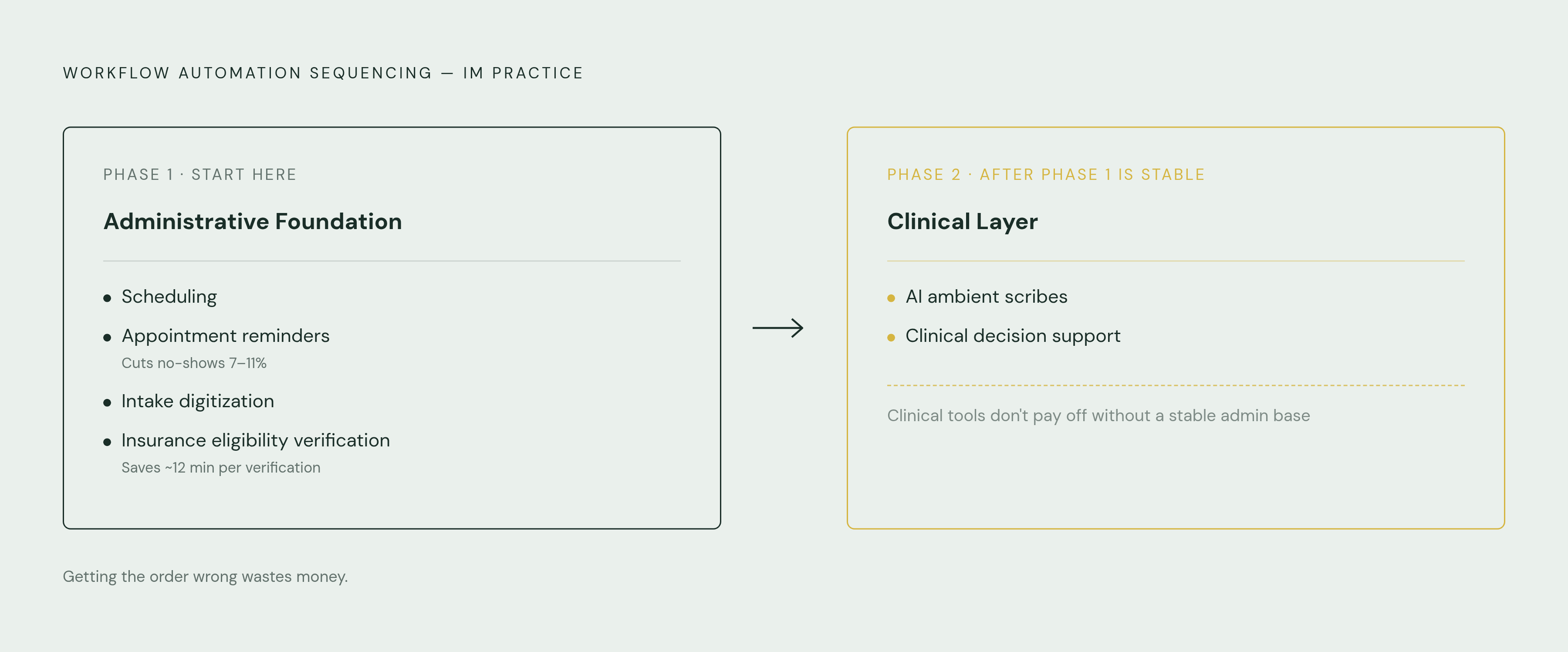
Other automation categories carry their own returns, though smaller ones. Automated appointment reminders sent at 48 and 24 hours before a visit cut no-show rates by 7 to 11%, and self-service rescheduling links take that burden off front-desk staff entirely. Multi-modality practices, where each practitioner type has a different appointment length, room requirement, and billing code, benefit disproportionately here, because manual scheduling coordination is where errors compound fastest.
Intake digitization matters too. Automated intake workflows sync directly into the patient's EHR profile and can trigger pre-visit instructions on their own. Functional intake forms, given their length and complexity, are exactly the kind of task automation is built to absorb. Insurance eligibility verification is another clear win: industry data puts the time savings at roughly 12 minutes per verification, which adds up fast in a practice running split-billing claims across multiple payer types on the same visit.
Lab result routing deserves its own mention, since IM practices juggling specialty and conventional lab sources face a manual routing burden that scales badly without automation. Prior authorization automation is close to mandatory at this point: Experian Health's State of Claims 2025 report found 41% of providers now see denial rates above 10%, up from 30% in 2022, while 86% of denials are preventable through upstream validation before a claim ever gets submitted. Medicare acupuncture billing, with its mixed payer logic, is particularly denial-prone without that kind of check built in.
The sequencing matters as much as the tools themselves, and getting it backwards wastes money. Scheduling, reminders, intake digitization, and eligibility verification are the fastest, lowest-complexity places to start. Clinical automation, ambient scribes and decision support included, works best once that administrative foundation is stable.
The interoperability constraints that limit what any automation layer can actually do
None of this automation runs on a clean data layer, and no vendor's feature sheet will tell you that upfront. Practices depend on labs, pharmacies, billing platforms, and third-party tools that are supposed to talk to each other through standards like HL7 and FHIR, but integration rarely works as smoothly in practice as it reads on a spec sheet. Data inconsistencies, API limits, and vendor-specific restrictions still produce fragmented workflows even when a system claims full interoperability support.
For IM practices, this shows up sharpest with specialty labs. DUTCH, Genova, and Vibrant America all sit outside the standard lab exchange networks most EHRs rely on. FHIR-based exchange is the intended fix, but how well any given vendor has actually implemented it varies a lot, and that variance is exactly where the problem of unstructured files buried in a documents tab keeps showing up.
Regulation is closing that gap, though slowly. CMS-0057-F, finalized in January 2024, requires FHIR-based APIs for prior authorization and patient access, with operational provisions starting January 1, 2026 and full deadlines beginning January 1, 2027. FHIR R6 is expected in late 2026, and its continued maturation should cut down on the migration churn vendors and practices have dealt with under earlier FHIR versions. EHR vendors that fall behind on FHIR compliance won't just create operational friction for the practices that depend on them. They'll create compliance exposure.
There's a security cost buried in all this too. HHS's Office for Civil Rights reported in 2025 that hacking and IT incidents remain the leading cause of healthcare data breaches, consistently the leading cause of reported healthcare data breaches, with unauthorized access and insider threats close behind, often traced back to insecure workarounds like unencrypted email. Practices stitching together three separate systems for billing, dispensing, and everything else are, by the nature of that patchwork, more exposed than practices running on one integrated platform.
Interoperability is a problem that predates automation. It's a standing constraint automation runs into, and any practice evaluating a new EHR or a new automation tool needs to ask not just what a system does, but what it can actually connect to, and on whose terms.
Sources
- Best Integrative Medicine EHR: 2026 Guide for IM Clinics
- 2026 Guide: Top EMRs for Integrative Medicine Clinics
- Top 10 Healthcare Workflow Automations for 2026
- Healthcare Workflow Automation: A Practical Guide for Operations Leaders
- The Functional & Integrative Medicine Industry’s Best EHRs
- Best EMR Systems for Functional Medicine Practices
- Top 9 Best EMRs for Functional Medicine Practices in 2026 | OptiMantra
- certifyhealth.com