The Clinical Note Telehealth Compliance
Telehealth Documentation Audits by Medicare Advantage Plans
- Published
- November 19, 2026
- Updated
- November 20, 2026
- Reading time
- 11 min read
Summary
CMS now audits every MA plan, and telehealth records are most exposed.
That single figure explains why the agency has moved Risk Adjustment Data Validation from a sporadic spot-check into something closer to a permanent fixture of the program.
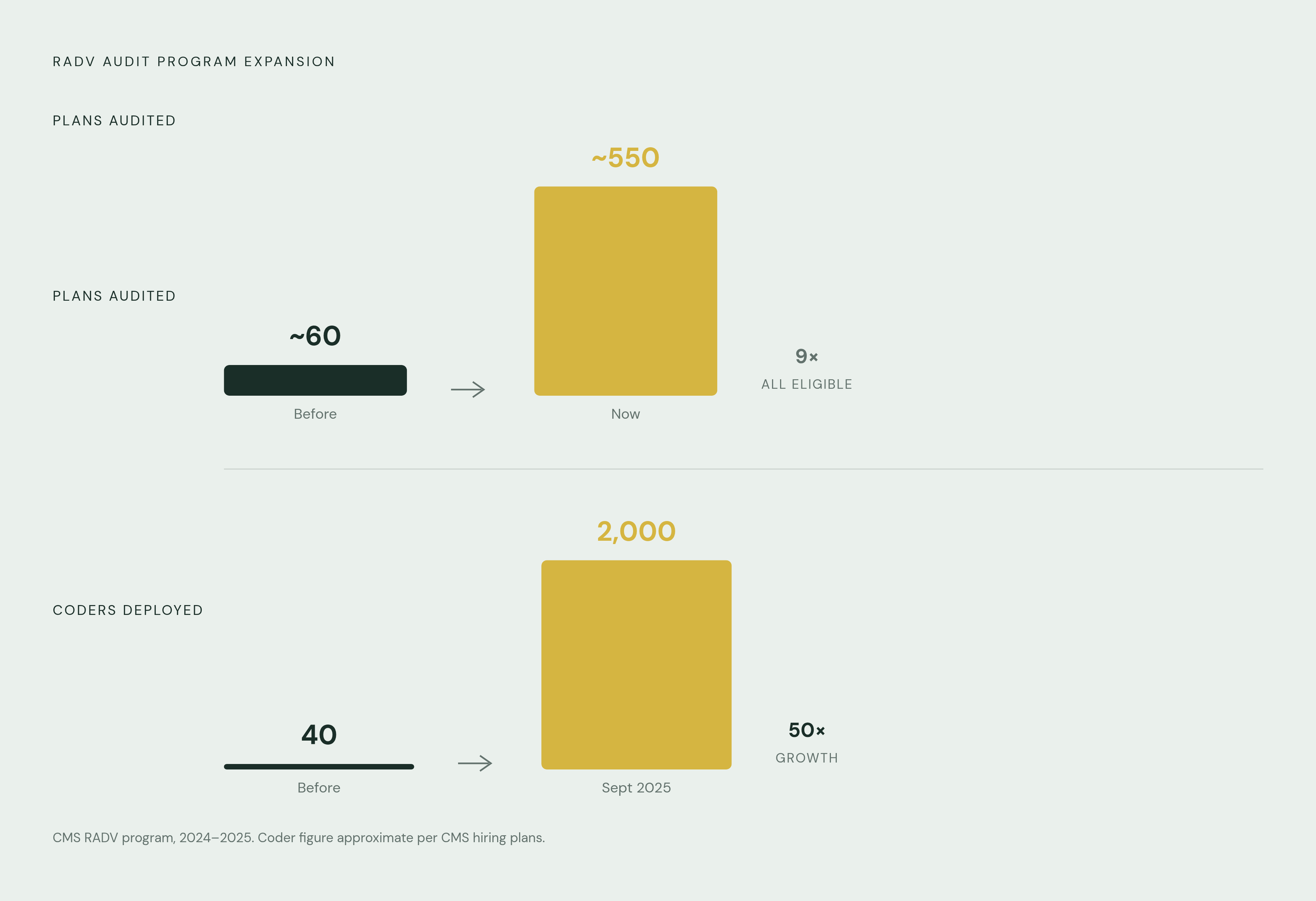
The scale of the shift is not subtle. CMS is expanding RADV from roughly 60 MA plans audited per year to all eligible MA contracts, which comes out to around 550 plans, and it has grown its medical coder workforce from 40 to approximately 2,000 by September 2025 to manually verify flagged diagnoses CMS Press Release on Medicare Advantage Audits. Quarterly is the operative word here. A program that once audited a handful of plans every so often is now reviewing records continuously, and every MA organization should assume its turn is either underway or imminent.
This is a payment integrity problem operating at the scale of the entire program, not a paperwork inconvenience, and telehealth sits at the center of it because so much of the documentation behind telehealth encounters was never built to withstand this level of scrutiny. It is a payment integrity problem operating at the scale of the entire program, and telehealth sits at the center of it because so much of the documentation behind telehealth encounters was never built to survive this kind of scrutiny.
What the extrapolation legal battle does and does not change about audit exposure
On September 25, 2025, a federal court vacated the entire 2023 RADV Final Rule on procedural grounds, and CMS appealed that decision on November 21, 2025. Some plans have read this as a reprieve. It is not one, and the distinction matters enough to spell out.
The ruling did not say extrapolation is illegal, and it did not say eliminating the FFS adjuster is illegal. It said CMS failed to follow the rulemaking procedure required to adopt those policies, a process defect. Audits continue regardless.
Even without extrapolation, a 200-enrollee sample carrying a meaningful share of unsupported diagnoses produces a real bill CMS Press Release on Medicare Advantage Audits RADV Audits 2026: What MA Plans Need to Know. The 2026 OIG audit of UnitedHealthcare of Wisconsin, under Contract H5253, recommended $46.9 million in repayment from findings limited to the sampled population HHS OIG UnitedHealthcare of Wisconsin Audit. So the legal fight lowers the ceiling on how bad a bad audit can get. It does not lower the floor, and plans treating the vacated rule as cover for lax documentation are misreading what actually happened in that courtroom. What remains in force is this: audits continue, and CMS can delete unsupported diagnoses and recover direct overpayments on sampled members even without extrapolation. CMS has committed to completing its backlog through PY 2024 regardless of Final Rule litigation.
OIG Audit Findings on Diagnoses Most Likely to Fail Record Review
Scale is easiest to see in a single number. OIG drew a stratified random sample of 97 enrollees out of 240,401 whose plans had submitted acute stroke diagnosis codes in 2020, and every single one of those codes failed to hold up against the medical record CMS Press Release on Medicare Advantage Audits HHS OIG Medicare Advantage Overpayments Report CodeMax MB. Not most. All of them. OIG's resulting estimate put plans' overpayment from unsupported acute stroke codes at $462 million in 2021 alone CMS Press Release on Medicare Advantage Audits HHS OIG Medicare Advantage Overpayments Report CodeMax MB.
That was not an isolated finding. A December 2025 OIG audit of a Humana contract based in a particular state turned up the same pattern of scrutiny directed at high-risk diagnosis codes, and the recurrence of that pattern signals an ongoing, systemic vulnerability in how those codes are documented and reviewed, regardless of the specific dollar figure involved. Diagnosis categories that carry high risk-adjustment weight draw audit attention precisely because a single unsupported code, multiplied across a large enrollee population, produces outsized financial consequences.
None of this is free, and none of it stays contained to the plans that get audited. MA overpayments in 2025 pushed Part B premiums up by $212 per person, a total of $13.4 billion spread across the entire Medicare beneficiary population Medicare Rights Center. The failure is socialized even though the documentation gap sits with individual plans and providers. And across nearly every OIG finding, the theme is consistent: these are not cases of fabricated diagnoses so much as records that exist but simply do not contain enough clinical detail to back up the code that got submitted. Telehealth encounters, it turns out, are especially prone to exactly that failure mode.
Disproportionate Audit Attention on Telehealth Encounters in 2026
The denial data makes the case better than any narrative framing could. Telehealth-related denials rose 84% year-over-year as of 2025, MDaudit found, making it the sharpest-growing denial category tracked Fierce Healthcare. The average denied amount on an MA-related claim climbed 22.4% to roughly $1,000 in 2025, and MA denial rates now exceed 17%, more than double the rate seen in traditional Medicare Fierce Healthcare Human Medical Billing. The administrative cost of disputing those denials has climbed past $25 billion industry-wide Human Medical Billing. Denial volume has stopped being purely a revenue problem and has become an operational one, consuming staff time that could go toward actual patient care Human Medical Billing.
Healthicity's read of the OIG's 2026 Work Plan priorities places telehealth alongside Chronic Care Management, Modifier 25, and MA risk adjustment as areas sharing one underlying weakness: documentation standards that were never tightened to match the scrutiny now being applied to them.
There is a structural reason telehealth landed here. It expanded fast, during a period when the rules governing it were shifting every few months, and a lot of the documentation habits providers built during the public health emergency simply do not clear post-PHE standards. Encounter notes written for a virtual visit during 2020 or 2021 were built to justify that the visit happened and that it should be paid CMS Press Release on Medicare Advantage Audits HHS OIG Medicare Advantage Overpayments Report CodeMax MB. They were not built to survive a risk adjustment validation review years later, and that gap between what the record was designed to do and what it is now being asked to do is the core of the problem. The denial rate and the OIG Work Plan priority list make the argument.
Documentation Complexity from Federal Extensions and MA Plan-Level Rules
Federal telehealth policy keeps moving, which does not help. On February 3, 2026, the President signed a funding bill extending key pandemic-era telehealth provisions through December 31, 2027, retroactive to January 30, 2026. That is a real extension, but it is not a permanent fix, and providers who treat it as settled law are setting themselves up for the next expiration date.
Even within Medicare, the rules are not uniform. Behavioral and mental health telehealth services can be delivered permanently via audio-only, while non-behavioral services face a different, more restrictive set of conditions. Layering MA plans on top of that federal baseline makes the picture more complicated still. UnitedHealthcare announced on October 6, 2025 that it would keep expanded MA telehealth coverage, including both audio-only and audio-video modalities, for certain in-home medical and mental health services through 2026, while separately dropping most remote patient monitoring coverage at a later date still unspecified as of this writing (an originally announced January 1, 2026 effective date for that change was delayed on December 17, 2025).
Changes to traditional Medicare FFS telehealth policy, including flexibilities that expired September 30, 2025, do not automatically carry over to MA plans. A provider treating patients across several MA contracts has to track which rule applies to which plan for which service type, and document each encounter according to the correct regime rather than a single generic telehealth template. There is no single number that captures this problem. The multiplication itself creates the difficulty: the sheer number of overlapping rule sets a documentation program has to satisfy at once.
The audio-only fault line: when a reimbursable service cannot support a risk adjustment diagnosis
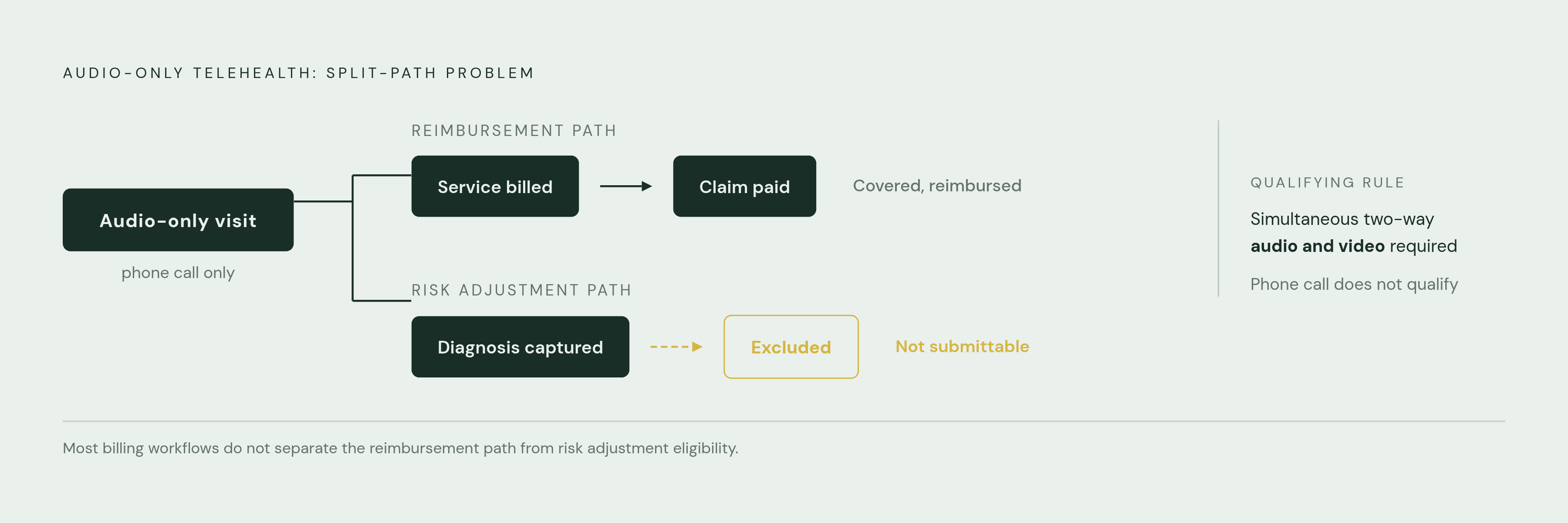
Here is the rule that trips up more plans than any other single technicality: audio-only services are not acceptable for Medicare risk adjustment purposes. To qualify, a service has to use interactive audio paired with simultaneous video that permits real-time, face-to-face communication. A phone call, however clinically thorough, does not meet that bar.
The consequence runs directly into a documentation trap. A diagnosis captured during an audio-only visit can be entirely reimbursable as a covered service, and still be barred from submission for risk adjustment. The service and its diagnosis take different paths through the system, and a lot of billing workflows are not built to separate them.
A genuine access tension produces this rule: video technology is often unavailable to beneficiaries, so audio-only visits meet a real need, yet the diagnoses generated in those visits get excluded. Plenty of Medicare beneficiaries cannot use video technology, or simply will not, and audio-only visits meet a real need for that population, even as the diagnoses generated in those visits get excluded from risk adjustment entirely. That is not a loophole to close so much as a structural trade-off in how the program is built.
For audit purposes, the fix is not clever coding. It is documentation that states the visit used simultaneous two-way audio and video. A note silent on modality gets treated exactly the same as one that confirms the visit was audio-only, meaning ambiguity itself is a finding. AAFP guidance states that, as of January 1, 2025, CPT Codes 99441–99443 are no longer available, Medicare did not adopt new audio-only CPT codes 98008–98015, and Modifier 93 should be appended to audio-only services.
Place-of-service coding errors: the top trigger for broader telehealth claim review
Two place-of-service codes govern how a telehealth claim gets paid. POS 02 applies when the telehealth visit happens somewhere other than the patient's home, and POS 10 applies when the patient is at home CodeMax MB. The distinction sounds minor. It is not, and treating it as minor is a mistake, because the distinction directly affects claim payment.
CMS Change Request 13582, effective for dates of service on or after January 1, 2024 and implemented that July, directs that POS 10 claims be paid at the non-facility rate, the same rate used for an in-office visit, while POS 02 pays at the facility rate, which runs an estimated 10 to 25% lower CMS Press Release on Medicare Advantage Audits RADV Audits 2026: What MA Plans Need to Know CodeMax MB. Get the code wrong and a practice either leaves money on the table or gets flagged for billing at a rate the encounter does not support.
The audit consequence compounds the problem of unpaid claims. CMS auditors treat POS mismatches as a signal of broader documentation failure, and a single wrong POS code can trigger review of a much larger batch of a provider's telehealth claims. OIG and Special Investigation Units identify POS errors as a top cause of reimbursement errors. They are now both underpaid on rate and flagged on audit risk simultaneously.
The most common modifier errors turning up in 2026 billing audits follow a short, recognizable list CMS Press Release on Medicare Advantage Audits RADV Audits 2026: What MA Plans Need to Know. Missing modifier 95 or 93 altogether tops it, alongside using POS 02 when POS 10 is required, and billing codes that are not eligible for telehealth as though they were CodeMax MB. None of these are exotic errors. They are habitual errors, and that habitual quality is why they appear so often in audit findings.
Requirements for a Telehealth Encounter Record to Survive RADV Review
A telehealth note that holds up under RADV review has a specific shape: it must include certain specific elements.
Modality has to be stated affirmatively: the record must say the visit used real-time, two-way audio and video, because a note that leaves this out gets treated the same as one confirming audio-only. Patient location has to appear too, specifying whether the patient was at home or at a clinical originating site, since that detail determines the correct POS code and the payment rate that follows from it. The diagnosis itself needs independent clinical support inside the body of the note: a code sitting in the assessment section without corresponding history, exam findings, or clinical reasoning elsewhere in the record will not survive validation, no matter how confidently it's stated.
Service eligibility matters just as much as modality. The service delivered has to appear on the CMS Medicare Telehealth List, and documenting that a covered service happened over telehealth means nothing if the underlying service was never eligible for telehealth delivery in the first place. Modifier accuracy closes the loop: 95 for audio-video, 93 for audio-only, and that modifier has to match what the note actually describes, because a mismatch between the modifier on the claim and the modality described in the record is itself a flag auditors are trained to catch. Where a visit genuinely was audio-only, the record should say so, explain that the patient could not or would not use video, and the diagnosis from that visit should never be submitted for risk adjustment in the first place.
Plans also need to run coding discipline in both directions. Submitting diagnoses that can be supported matters, but plans must also delete the ones that cannot be supported, and CMS itself watches add-only submission patterns as an enforcement signal. Wolters Kluwer's guidance points to CDI-coder-provider feedback loops as one practice, alongside proactive deletes and tighter documentation discipline, for improving validation rates against RADV's compressed audit timelines.
Closing the Gap Between Current Documentation Practices and RADV Standards
Closing this gap starts with holding internal documentation to the exact standard CMS applies during review: does the encounter note, read on its own with no outside context, support both the diagnosis code submitted and the modality claimed? Most compliance programs that fail RADV review are not failing because of some obscure technicality. They're failing because nobody in the organization asked that question before the auditor did.
Because MA plan telehealth rules diverge from Original Medicare and from each other, a payer-specific registry tracking each plan's covered services, modality rules, and POS requirements has stopped being optional. Denial data deserves the same granular treatment: reviewing telehealth denials by code, by modality, and by POS designation reveals systematic documentation gaps before they turn into audit findings, and an 84% year-over-year jump in denials demands a structural response rather than being noise to wait out Fierce Healthcare.
Technology has a defined role here, not an unlimited one. CMS itself is deploying AI to support its certified human coders during RADV review, and MA plans can apply the identical logic on their own side, using automated flagging to catch documentation gaps, modality mismatches, and POS inconsistencies while leaving the final clinical judgment to a human reviewer. Cadence needs to follow CMS's lead too. With RADV audits now launching quarterly, an internal review conducted once a year no longer matches the pace at which exposure can build.
None of the standard is a mystery. The audit criteria are published, the OIG Work Plan lays out its priorities in plain language, and the failure modes that keep appearing in telehealth documentation are recorded across audit after audit. The plans and compliance programs building their internal review process directly against those known criteria, rather than guessing at what auditors want, are the ones positioned to survive the next round of scrutiny instead of becoming its next case study.
References
- RADV Audits 2026: What MA Plans Need to Know Informed the discussion of RADV audit scale, sample-based exposure, and common 2026 audit errors.
- https://oig.hhs.gov/reports/all/2026/medicare-advantage-compliance-audit-of-specific-diagnosis-codes-that-unitedhealthcare-of-wisconsin-inc-contract-h5253-submitted-to-cms/ Provided the $46.9 million repayment recommendation from the UnitedHealthcare of Wisconsin audit.
- UHC Continues Some MA Telehealth Benefits in 2026 | Telehealth.org Supplied the details of UnitedHealthcare's decision to keep expanded MA telehealth coverage through 2026 and the delayed remote patient monitoring change.
- CMS Guidelines for RADV Audits You Need to Know | Wolters Kluwer Provided the guidance on CDI-coder-provider feedback loops, proactive deletes, and improving validation rates under compressed audit timelines.
- Telehealth policy updates | Telehealth.HHS.gov Background on the federal telehealth extension and the expired flexibilities that complicate documentation.
- https://www.mintz.com/insights-center/viewpoints/2146/2025-10-01-radv-odyssey-extrapolation-vacated Covered the vacatur of the 2023 RADV Final Rule on procedural grounds and what it does and does not change.
- https://www.wilmerhale.com/en/insights/client-alerts/20251223-oig-audit-of-humana-medicare-advantage-contract-underscores-continued-scrutiny-of-high-risk-diagnoses-and-ongoing-disputes-over-audit-methodology Source for the December 2025 OIG audit of a Humana contract and its focus on high-risk diagnosis codes.
- https://www.healthicity.com/blog/oig-work-plan-2026-the-10-priorities-healthcare-compliance-officers-need-to-know Supplied the reading of OIG 2026 Work Plan priorities that groups telehealth with CCM, Modifier 25, and MA risk adjustment.
How to cite
Meera Sundaram. Telehealth Documentation Audits by Medicare Advantage Plans. The Clinical Note. November 19, 2026. theclinicalnote.com/posts/telehealth-documentation-audits-by-medicare-advantage-plans
© 2026 The Clinical Note