Minor Patient Consent Rules for Telehealth Across States
State rules on who can consent to a minor's telehealth care shift with every state line crossed.
Telehealth jurisdiction follows the patient. State licensing law attaches clinical authority to wherever the patient sits during the call, regardless of where the provider's office happens to be. That single fact reshapes how any organization serving minors virtually has to think about consent, because the rulebook changes every time the patient crosses a state line, even temporarily.
Consider what that looks like in practice. A patient registered with a New York practice who logs into a video visit from a New Jersey vacation home is, for legal purposes, having a New Jersey visit. Location isn't a static field on an intake form. It's a per-visit clinical fact that has to be checked at the moment of care, not assumed from a mailing address on file.
That single fact fans out into five separate rulebooks that govern one telehealth encounter simultaneously. HIPAA attaches to the data and stays uniform everywhere. State licensing law attaches to the clinician's authority to practice, and it's set by the patient's state. Federal drug law attaches to the medication being prescribed. 42 CFR Part 2 attaches specifically to substance-use-disorder records. And state mental-health and minors' law attaches to the patient: their age, their condition, and who is legally allowed to consent on their behalf or read their chart.
For minor patients, that fifth rulebook is where things get complicated. A platform or compliance team is most likely to be surprised by this layer after the platform has already launched. The stakes aren't abstract, either. Unlicensed practice is a criminal offense in most states, and malpractice insurance routinely excludes coverage for care delivered without a valid license. Getting the jurisdiction wrong creates an exposure problem, for the clinician and for the platform that scheduled the visit.
How broadly telehealth-specific consent requirements now reach across the country
The scale of this warrants a moment of reflection. As of the CCHP Fall 2025 review, 45 states, the District of Columbia, and Puerto Rico include some form of telehealth-specific informed consent requirement in their statutes, administrative codes, or Medicaid policies. That's close to the entire country operating under some version of a telehealth consent mandate.
But the headline count flattens a lot of variation. Some of these requirements apply broadly to every telehealth encounter in the state. Others are narrower, limited to particular specialties, or triggered only when Medicaid is the payer. A platform that treats "45 states require consent" as a single compliance checkbox will miss the fact that the actual obligation looks completely different depending on which state and which payer are involved.
The mandate also doesn't care about modality. Whether the visit happens over video, audio-only, store-and-forward imaging, or remote patient monitoring, the consent requirement still applies. Consent generally has to be secured before or at the start of the encounter and then documented in the medical record, and that baseline holds even where states diverge sharply on format. On top of that baseline, Medicaid programs frequently add their own layer. Many state Medicaid programs specify how consent has to be captured, and they can tie payment to whether that capture happened correctly. So the regulatory surface here is large, and the variation inside it is the actual problem. A framework for organizing that variation is the only thing that makes it manageable.
The default rule: parental or guardian consent is the starting point for most telehealth visits involving minors
Start with the baseline. In most states, telehealth services for minors require parental or guardian consent, either alongside the minor's own consent or in place of it. That default appears repeatedly in state code, though the exact wording shifts from state to state.
New York states it directly: where the telehealth recipient is a minor, consent has to be provided by the parent, guardian, or another person with legal authority to consent to health care on the minor's behalf, and the minor retains the right to withdraw consent at any time. New York's mental health rules add another layer on top of that: informed consent must be obtained before or during the first visit, and the minor's parent or guardian has to be told how to verify the telehealth practitioner's professional license.
Alabama's Medicaid program takes a stricter approach. Telemedicine services provided to minors under the age of medical consent require a parent or legal guardian to actually attend the visit, whether in person or virtually worldpopulationreview.com. That's a meaningfully higher bar than simply documenting that consent was given somewhere in advance.
Texas splits the difference by service type. A parent or legal guardian must give written or verbal consent to the distant-site provider before anyone else can be physically present in the room during a child's telehealth visit. For physical therapy, occupational therapy, and speech therapy delivered via telehealth, though, verbal consent is enough, as long as it gets documented in the medical record.
Georgia's teledentistry rules add a location-verification piece: the authorizing dentist has to confirm both the patient's identity and their physical presence in-state, and obtain parental or guardian consent if the patient is a minor. Michigan's school-based telehealth rule introduces a genuinely useful nuance. If a parent has already given consent that remains "currently effective," a health professional performing an assessment or treatment via telemedicine at a school site doesn't have to verify the parent is physically present at that moment, though a child still can't be seen without that underlying consent in place. Pre-authorized consent, in other words, can satisfy the requirement without demanding real-time parental presence. That distinction matters for any provider trying to build scalable school-based telehealth programs, since it means the consent event and the treatment event don't have to be simultaneous.
Where the default breaks down: the recognized categories of minor self-consent
The parental-consent default isn't absolute. Certain categories of care carry recognized exceptions where minors can consent on their own, and those categories cluster around sensitive services: substance use, mental health, sexually transmitted infections, and reproductive health, though the specifics still vary by state.
STI care is the most consistent exception in the entire landscape. Every state, plus the District of Columbia, allows minors to consent to testing and treatment for sexually transmitted infections, with no state holding out on this one worldpopulationreview.com. That uniformity stands in sharp contrast to nearly everything else in this piece.
Mental health is far messier. Most states allow minors somewhere between ages 12 and 16 to consent to their own mental health treatment worldpopulationreview.com. But 18 states either set the consent age at 18 or don't grant minors any independent consent right for mental health services at all. More than a third of the country operates on a fundamentally different rule.
Even where minors can consent to mental health treatment on their own, that right typically stops short of psychiatric medication management or inpatient hospitalization. Prescriptions and admissions almost always still require parental or guardian consent, with narrow exceptions for emancipated minors or true emergencies. So a minor might be able to walk into (or log into) a therapy session without a parent's sign-off, but the moment medication enters the picture, the default swings back toward requiring parental involvement.
Reproductive health carries its own patchwork. Vermont has no parental consent requirement at all for minors seeking contraception or abortion care, and minors of any age can receive medical care connected to rape, incest, or sexual abuse without needing parental sign-off. Those in-person rights carry over to telehealth delivery, which matters enormously for platforms trying to serve reproductive health virtually across state lines. When a minor can legally consent to a service, that minor should also be able to receive that treatment confidentially. The self-consent right and the confidentiality right move together, not separately.
How mental health consent age thresholds vary state by state, with specific examples
Most states cluster their mental health self-consent age somewhere between 12 and 16, but that range obscures how different the actual rules look once you get into specific states.
California sets its threshold at 12, one of the youngest in the country, though it comes with a qualifier: the minor also has to be mature enough to participate intelligently in treatment. That right covers outpatient mental health treatment and counseling through a qualified professional, but it stops well short of inpatient treatment, psychotropic medication, convulsive treatment, or psychosurgery. So even at the youngest end of the spectrum, self-consent has a hard ceiling.
Maryland lowered its own threshold from 16 to 12 in 2021, a useful reminder for anyone relying on older compliance references: these thresholds move, and a provider's records have to reflect the law as it stands today, not the law as it stood when a policy was first written.
Connecticut takes a structurally different approach. Rather than setting an age threshold, Connecticut allows minors to receive as many counseling sessions as necessary without parental consent, with no session cap. That's a session-based model, and it requires its own separate compliance logic.
Alabama complicates things further by using a multi-criterion model instead of a single age cutoff. Under Alabama Code § 22-8-4, a minor can consent to legally authorized mental health services if they're 14 or older, or have graduated high school, or are married or divorced, or are pregnant youthlaw.org. Age is just one of several qualifying conditions, not the sole gate.
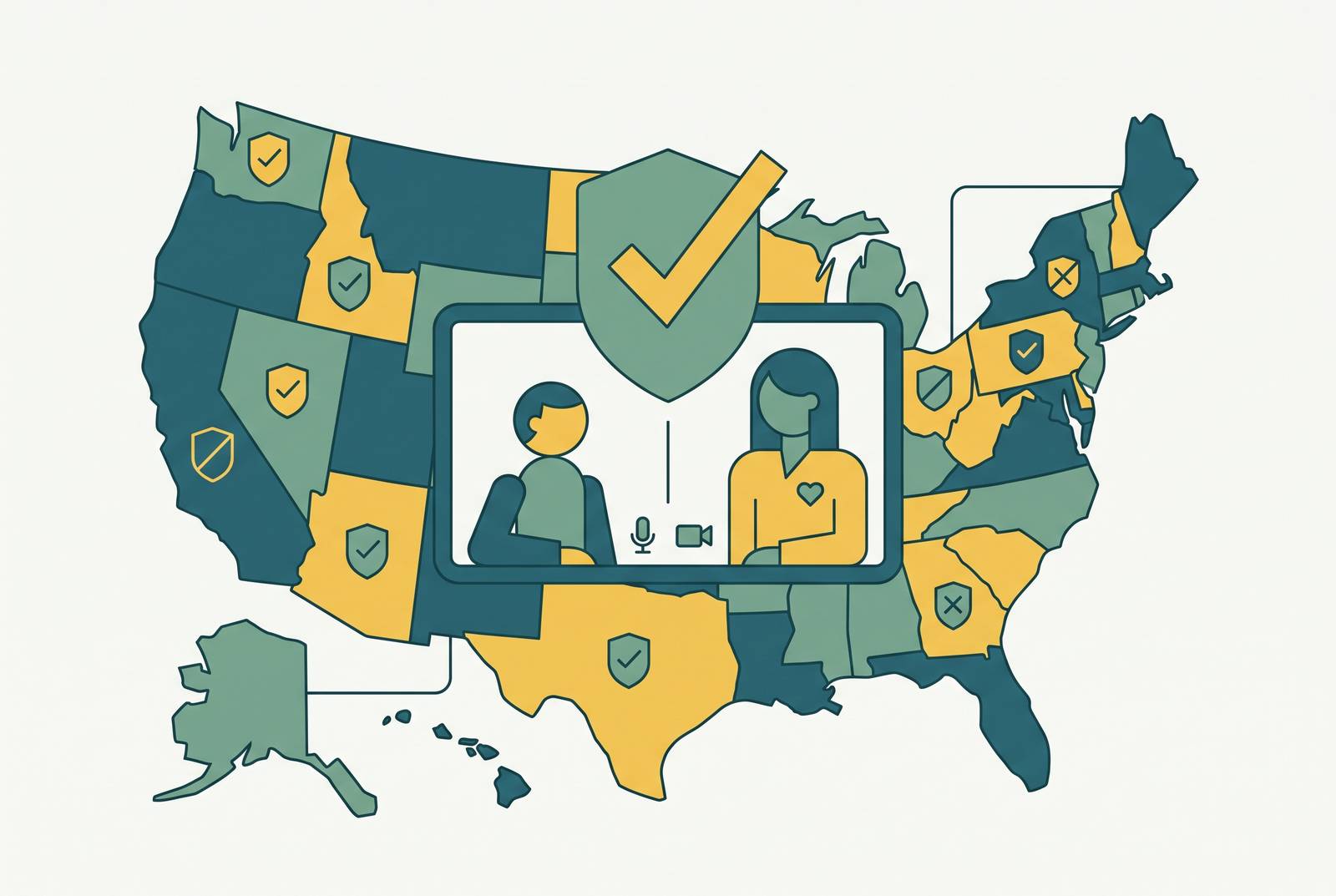
California's model deserves particular attention here, because it doesn't stop at the self-consent right. It also carries a Medicaid-specific program that extends that right explicitly into telehealth delivery. State-specific thresholds, all from World Population Review and NCYL Minor Consent Compendium 2024, vary state by state, with specific examples for how mental health consent age thresholds differ.
California's Minor Consent Program as a model for how Medicaid layers onto state self-consent rights
California runs something called the Minor Consent Program, which covers sexual health, reproductive health, and mental health services. Minors who qualify for confidential care under that program can consent to receive the same services via telehealth that are appropriate for telehealth delivery in the first place. The self-consent right, in other words, doesn't disappear when the visit moves from an exam room to a video call.
The confidentiality mechanism behind this is built into the billing infrastructure itself. Minors accessing limited-scope Medi-Cal Minor Consent Services get assigned to a separate Medi-Cal case, distinct from the parent or guardian's case, and the minor's Social Security Number can't be used on that case. That's a deliberate technical separation designed to keep the parent's Medi-Cal records from ever showing the minor's confidential care.
That confidentiality isn't unlimited, though. Outpatient mental health treatment or counseling delivered through limited-scope Medi-Cal stays confidential except to the extent that parent or guardian involvement is separately required by law. So the right bends where other legal obligations, like mandatory reporting, require it to.
What California's model demonstrates, more than any individual rule inside it, is that a state's self-consent framework, once properly mapped into Medicaid, creates an operationally distinct patient pathway. It's not enough for a telehealth platform to know that a minor can consent to a service. The platform's billing, enrollment, and case-management systems all have to recognize that pathway and route the minor's claims and records through it correctly, separate from the parent's.
How Medicaid programs in other states add consent requirements specific to telehealth delivery for minors
California isn't unusual in tying Medicaid policy to telehealth-specific consent rules for minors. The CCHP Fall 2025 report found this is a documented trend across states.
Arkansas's Medicaid Autism manual requires parental or guardian consent specifically for services delivered via telemedicine. The specialty-specific framing matters here: the rule applies within that manual even if the broader Arkansas statute governing minor consent is less specific on the point.
Oregon's school-based health services rules take a broader documentation-first approach. Before delivering any covered service through telemedicine or telehealth, providers have to obtain and document consent, whether written, oral, or recorded, from the child or their parent or guardian, and those rules also have to address consent for treatment, data collection, and data sharing.
Alabama's Medicaid program repeats its general minor rule inside the telehealth context specifically: a parent or legal guardian must attend the telemedicine visit. That's a stricter standard than a documentation-only requirement, and it shows up twice in Alabama's regulatory structure, once as a general rule and once reinforced at the Medicaid level.
The throughline is the principle from Accountable's 2026 guide: Medicaid telehealth consent rules can be stricter than commercial payer rules, and payment may be tied to compliance. A missing consent document under Medicaid carries a reimbursement risk too, and claims can get denied over exactly this kind of gap. Payer-specific consent steps need to trigger automatically based on the patient's location and payer at the moment of scheduling. Handling this manually at the point of care, after the visit has already started, is too late to catch most of these requirements reliably.
Emancipated minors and the "mature minor" doctrine: when a minor controls their own consent entirely
A court-emancipated minor sits outside nearly all of the rules described so far. In every state, an emancipated minor can generally give their own consent and controls their health information the same way any adult patient does: they can authorize disclosures, request restrictions, and exercise access rights without any parental involvement.
Court emancipation isn't the only path there, either. Several states recognize situational emancipation through marriage, active military duty, or, in some states, through living separately from parents or independently managing one's own financial affairs. States without a specific emancipation statute on the books sometimes rely instead on "mature minor" rules, which let a provider extend consent rights to a minor judged competent enough to understand their own situation. That's a meaningfully different kind of standard: it's assessed by the clinician in the moment, not fixed by a statutory age cutoff the way most of the rules discussed earlier are.
The HIPAA consequence of emancipation is significant and easy to overlook. Once a minor is established as emancipated, a parent who would otherwise have record access under HIPAA's minor exception loses that access entirely. The minor's records become theirs alone, in the same way an adult patient's records belong only to them. Any platform serving minors has to be able to document and enforce that distinction at the individual record level, not just at the account level.
That enforcement depends entirely on documentation quality. Whatever establishes the emancipation, a court order, a marriage certificate, a military ID, has to be captured and retained as part of the consent record itself, and it can't be assumed from what the patient simply reports at intake. A self-reported claim of emancipation, without the underlying document on file, doesn't hold up if the consent record is ever questioned later.
Consent documentation requirements and how format differs by state
None of the categories above matter much if the documentation behind them can't hold up to scrutiny.
Format requirements diverge from there in ways that mirror everything covered above. Some states, like Alabama, want physical or virtual attendance from a parent worldpopulationreview.com. Others, like Texas, accept verbal consent for specific therapy services as long as it's documented afterward. Oregon accepts written, oral, or recorded consent, provided the record also covers treatment, data collection, and data sharing. New York requires that consent be obtained before or during the first visit and that the minor's parent or guardian be told how to verify the practitioner's license.
None of these formats are interchangeable, and a documentation template built for one state's requirements will fail to satisfy another's. The only durable approach is one that treats consent capture as a per-visit, per-state, per-payer determination rather than a single form filled out once at intake. Given how many states have moved to formalize telehealth-specific consent rules for minors, and how much Medicaid programs continue to layer onto those state defaults, that determination isn't a compliance afterthought. It's the operational foundation the entire visit depends on. Documentation must show core elements, per Accountable's guide, and format requirements for consent documentation differ by state.