The Clinical Note Practice Operations
Scope of Practice Boundaries for Telehealth Health Coaches and Navigators
- Published
- November 23, 2026
- Reading time
- 9 min read
Summary
Telehealth doesn't widen a coach's authority, and these are the lines to hold.
Telehealth expands access to health coaching and navigation, but it does not expand either role’s authority. To practice safely and in a way they can defend under the law, coaches must keep education and behavior-change support separate from clinical care. That distinction must govern not only conversations with clients, but also cross-state services, platform workflows, AI tools, and the emerging Medicare reimbursement pathway.
What health coaches and navigators actually do, and what distinguishes that from clinical care
Health coaches help clients set goals, make action plans, build healthy habits, and work through what gets in their way. Their tools are education, accountability, and support for self-directed change. A session might cover meal planning frameworks, habit stacking, or stress management techniques. The client is still responsible for choosing goals and working toward them. The coach helps make those goals workable rather than determining what medical treatment the client needs.
The NBHWC describes the coach as an “accountability partner, not director,” supporting goals consistent with the client’s vision and informed by prescribed treatment plans. That distinction separates teaching balanced plate concepts or sleep hygiene from designing a renal diet for someone with kidney disease. The former provides general education. The latter treats a diagnosed condition and requires clinical credentials. Health navigators share this non-diagnosing, non-prescribing role, but their settings, training requirements, and program goals vary, and they lack a national licensing framework equivalent to the NBHWC credential.
Why telehealth sharpens these boundaries rather than relaxing them
The 2026 Florida Statutes § 456.47 require telehealth providers to practice consistently with their scope and the prevailing professional standard for comparable in-person services. The screen creates no new clinical permissions. Coaches and navigators therefore cannot provide a service remotely that they lack authority to provide in person. What changes is the context in which clients ask for help. A coach who becomes the client’s primary digital contact may receive clinical questions that would otherwise go to a physician.
Asynchronous communication makes it harder for coaches to keep that pressure in check. A client can send lab results through an app or describe symptoms in a late-night message, expecting an answer from the person most readily available. A typed interpretation remains clinical in a brief reply as well as in a consultation. Telehealth thus requires coaches to stay within scope in their daily work as well as during formal appointments.
The five specific lines coaches cross most often, and why each one is risky
Diagnosing crosses the first line between education and treatment. When a client describes fatigue and joint pain, the coach’s role is to redirect the symptoms to a physician while supporting sleep and stress habits. The distinction is consequential. Unlicensed practice of medicine has resulted in felony charges, so a tentative-sounding suggestion is not a safe substitute for referral.
Teaching balanced plate concepts, whole foods, and meal preparation is general education, while designing a renal diet or an elimination protocol for IBS is Medical Nutrition Therapy and requires a registered dietitian credential. The diagnosis changes the purpose of the advice. A protocol intended to treat a condition is not ordinary meal-planning support.
Interpreting lab results moves a coach from general education into a clinical assessment of one person. A coach can explain what health markers generally indicate, but cannot tell a client that their LDL is too high and prescribe dietary changes in response. Digital access makes this request especially likely. Receiving the results does not confer authority to interpret them.
Overriding medical advice substitutes the coach’s judgment for clinical direction. When a physician has prescribed medication, a dietary restriction, or an exercise limit, coaching supports that guidance rather than validating the client’s disagreement with it.
Claiming to treat, cure, or reverse a condition crosses the boundary even before a session begins. “Reverse your diabetes” is a clinical claim, while “build nutrition and movement habits that support metabolic health” describes coaching. Course descriptions, social media, and other copy that clients see must describe the service the coach is allowed to provide.
How dual roles and AI tools create additional crossing-points
Additional credentials can widen a practitioner’s authority without widening the coaching role itself. A coach who also holds an active credential as a nurse, dietitian, or therapist may provide services within that credential’s scope. The professional capacity must be explicit. Choosing a role with care, recording it, and explaining it clearly help keep clinical care within the practitioner's authority and prevent an unmarked shift into that work. Without that separation, the client cannot tell which role the advice came from, and the encounter record leaves it unclear.
A chatbot embedded in a coaching or navigation platform can generate diagnostic statements or treatment advice attributable to the platform and potentially to the coach operating it. Pennsylvania’s State Board of Medicine filed suit against Character Technologies in May 2026 in state Commonwealth Court, alleging that its chatbot Emilie engaged in unauthorized medical practice under Pennsylvania’s Medical Practice Act. The chatbot had logged tens of thousands of user interactions as of April 17, 2026. The suit is the first state medical board enforcement action of its kind against an AI product, although the allegations are not a finding of liability.
Even a useful AI feature must keep its responses within the service the platform may lawfully provide. Oregon’s HB 2748, effective January 1, 2026, separately prohibits AI from using protected professional nursing titles. Broad state statutes may also reach the act of presenting an AI tool as authorized to provide medical guidance. Human intent alone does not settle the exposure.
Why practicing across state lines multiplies every boundary risk
A coach or navigator serving someone in another state is subject to that state’s laws, whether or not the practitioner holds a license there. An activity treated as coaching in one jurisdiction may fall within regulated nutrition, counseling, or medicine in another.
Clinical credentials do not eliminate that burden. Licensed clinicians generally need active, unrestricted authority to practice in each patient state. The VA final rule issued October 2, 2025, effective November 3, 2025, creates a specific federal exception for VA health care professionals providing telehealth within their VA employment. It does not extend to independent coaches or navigators. For platforms with prescribers, federal controlled-substance registration likewise does not replace state authority and requires separate registration for each state where controlled substances are dispensed.
Some states offer narrower telehealth registration routes. Florida § 456.47(4) permits qualifying out-of-state providers to register if they hold an active, unencumbered, substantially similar license, have no disciplinary history in the prior five years, and designate a Florida registered agent. That route applies only to provider types Florida licenses. Health coaches are not among them. A pathway available to a platform’s clinicians therefore cannot be assumed to cover its coaching staff.
What telehealth platforms get wrong when coaches and navigators are embedded in clinical workflows
The way a platform is built can push staff without licenses into clinical work even when no coach deliberately goes beyond scope. When the coach is the primary digital contact in a billed encounter, the workflow routes clinical questions to a clinician or leaves them with the coach. Routing is therefore a professional-boundary decision. State board scrutiny of telehealth weight-loss services has included allegations of prescriptions issued without a proper physician-patient relationship and unlicensed individuals influencing clinical judgment. Related lawsuits have challenged organizations’ undue influence over medical decisions and prioritization of financial gain over patient need.
Billing adds exposure beyond professional discipline. The DOJ’s 2025 Health Care Fraud Takedown named 324 defendants, with telehealth cases alleging health care fraud, wire fraud, and, in some civil cases, False Claims Act violations. The alleged conduct included billing for services that were undelivered, unnecessary, or delivered in a different capacity than represented. Those distinctions link staffing and workflow to the accuracy of claims. They also show why organizational failures can involve federal criminal exposure as well as civil liability.
Uneven navigator training compounds the organizational risk. Without consensus on what a navigator is authorized to do, platforms may assign clinical responsibilities to a role that lacks consistent preparation or authority. Patients may not recognize that distinction when advice arrives through a clinical service. Advice from an unqualified source can also leave them without medical malpractice recourse. Embedding a navigator in a clinical workflow does not itself make the navigator a clinician.
How the emerging Medicare reimbursement pathway changes the stakes for scope compliance
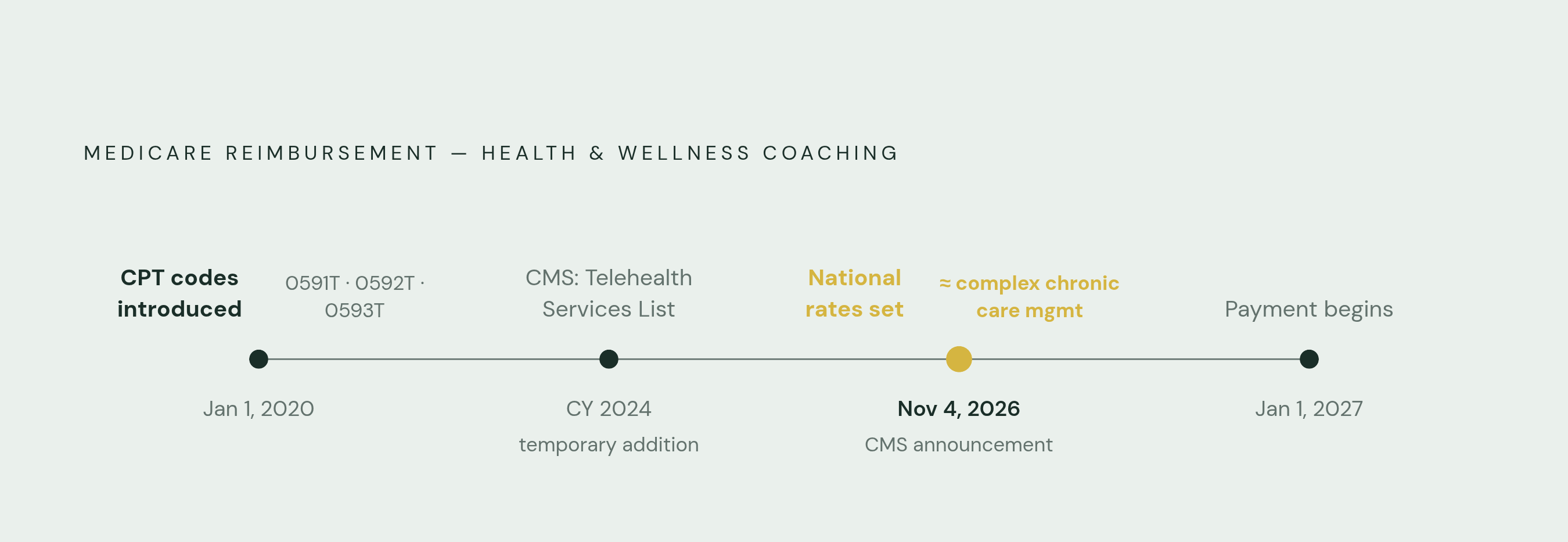
Medicare reimbursement brings coaching into a more formal oversight framework. CPT codes 0591T for initial individual coaching, 0592T for follow-up individual coaching, and 0593T for group coaching have been in use since January 1, 2020. CMS temporarily added them to the Medicare Telehealth Services List for calendar year 2024. On November 4, 2026, CMS announced the national rates it would pay for these services starting January 1, 2027. CMS valued 0591T and 0592T at the level of complex chronic care management codes.
CMS has also finalized a Medicare definition of Health & Wellness Coaching built on the CPT framework, naming the NBHWC among qualifying certification pathways. That gives its scope definition a formal regulatory foothold. Payment recognition does not confer clinical authority. Instead, it makes the distinction between coaching and treatment part of a framework in which the service must be documented and represented accurately.
Some elements remain proposed or unresolved. Under the proposal, supervising clinicians or organizations bill Medicare for coaches' services, keeping clinical oversight in place. Whether dedicated HCPCS G-codes will eventually replace the Category III CPT codes remained unresolved as of the announcement. The proposed billing structure raises concrete questions about who controls clinical content and what the coach may do during a billed encounter. Platforms that misrepresent those services could face claims under the False Claims Act, so staying within scope is part of accurate billing as well as a professional duty.
What defensible telehealth coaching practice looks like in concrete operational terms
The practical response is to build boundaries into routine work. Florida § 456.47(3) requires telehealth providers to document services to the same standard as in-person care. That principle provides a risk-management baseline elsewhere, even where not expressly mandated. For practitioners with dual roles, records must show which professional role they were working in during each part of an encounter.
Referral language is another operational safeguard. A coach can say, “Those symptoms are worth raising with your doctor — in the meantime, let's work on the sleep and stress habits that support your overall energy”. The response preserves the relationship while redirecting clinical judgment. The same approach applies when a client shares lab results. Behavior change and habit implementation remain legitimate coaching work. Interpreting the findings and prescribing a response do not.
Coaches entering a new state should verify its licensure requirements, particularly for nutrition, counseling, and medical advice. CCHP’s state-by-state resource, updated August 2026, offers a starting point, while advice from an attorney in the relevant state is prudent for multi-state practice. AI tools need to be checked for what they generate, including responses that sound like diagnoses and advice on treatment. The Pennsylvania action makes content governance a scope responsibility.
Credential alignment completes this operational foundation. Maintaining NBHWC certification and working within its scope definition increasingly supports professional legitimacy and eligibility under the emerging reimbursement framework. Coaches on billing platforms also need to understand the supervising clinician’s expectations and the documentation required for Medicare sessions. Those requirements make clear boundaries a basis for credible practice. The structural changes arriving in 2027 reward coaches who have already made that discipline part of daily work.
References
- State Telehealth Policies for Cross-State Licensing - CCHP Provided the state-by-state cross-state licensing resource the article points coaches to when entering a new state.
- The 2026 Florida Statutes Supplied the Florida telehealth standards on scope, documentation, and out-of-state provider registration.
- NBHWC Health & Wellness Coach Scope of Practice Supplied the NBHWC definition of the coach as an accountability partner within the scope of practice.
- Federal Register :: Health Care Professionals Practicing Via Telehealth Source for the VA final rule and its narrow federal telehealth exception for VA employees.
- Working between systems: an umbrella review of care navigator roles and responsibilities Informed the discussion of varied navigator roles, training, and the lack of consensus on their authority.
- Is Health Coaching Legal? Avoid Licensing Risks! Informed the risks of unlicensed practice of medicine, including criminal exposure, and how coaches should describe services.
- Balancing Act: Generative AI Tools and Scope of Practice in Health Coaching - Northern Arizona University Informed the discussion of generative AI tools creating scope-of-practice risk in coaching platforms.
- Coaching and Counseling Across State Lines: Legal Compliance for Multistate Wellness Businesses Supported the point that serving clients in another state subjects coaches to that state's laws.
How to cite
Theo Okonkwo. Scope of Practice Boundaries for Telehealth Health Coaches and Navigators. The Clinical Note. November 23, 2026. theclinicalnote.com/posts/scope-of-practice-boundaries-for-telehealth-health-coaches-and-navigators
© 2026 The Clinical Note