Referral Coordination Workflows in Virtual Integrative Care Settings
Coordinating care across separate platforms and disciplines creates predictable handoff failures.
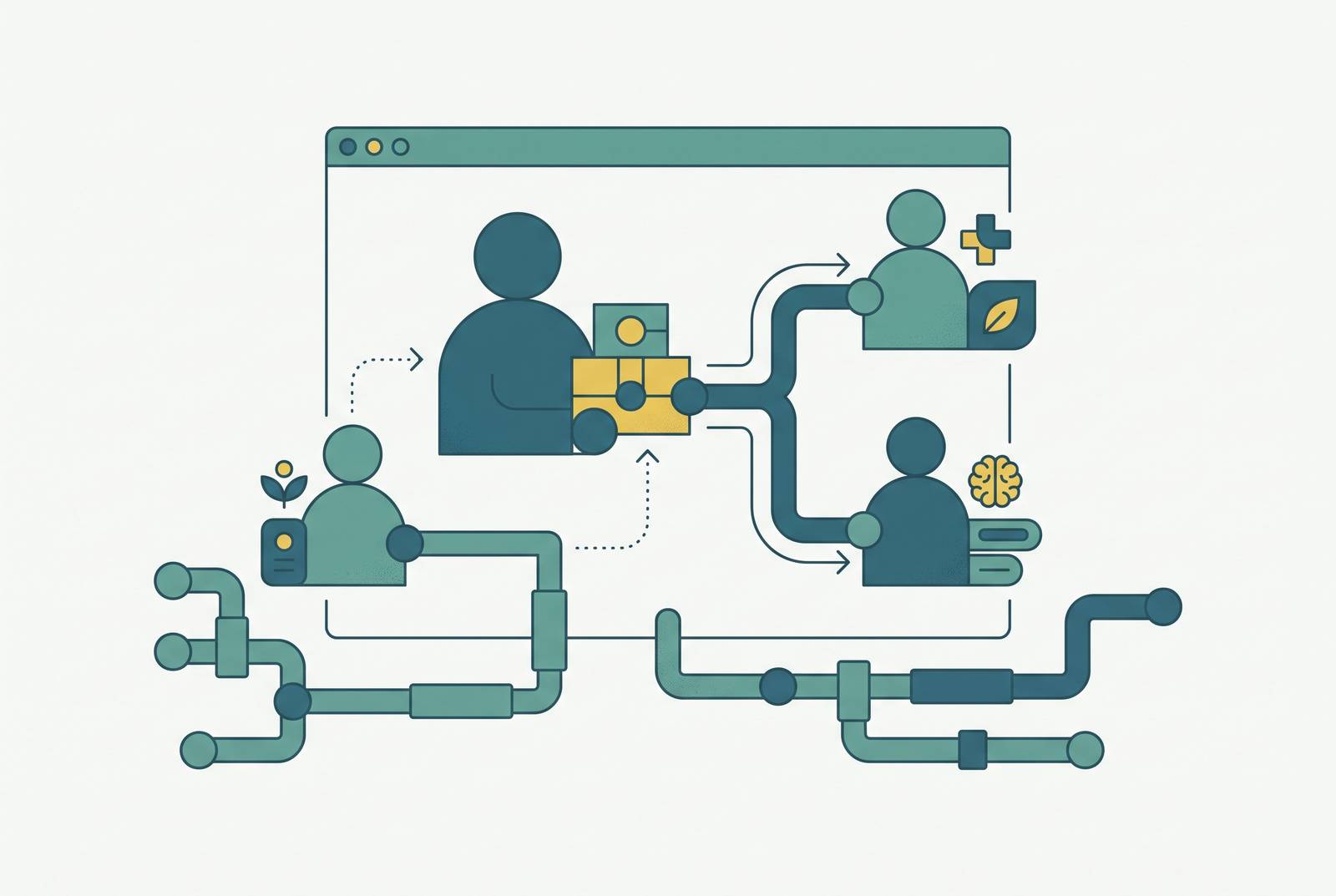
Virtual integrative care brings conventional medicine together with functional medicine, nutrition, behavioral health, and mind-body therapies, delivered largely through telehealth. The same feature that makes it clinically valuable, the fact that it spans distinct disciplines working on separate platforms, under separate licensure rules, with separate documentation standards, is what makes referral coordination inside it so fragile.
Why referral coordination in virtual integrative care fails at disciplinary seams
The clinical case for integrative care rests on combining perspectives that, taken alone, miss something: a primary care provider managing a chronic condition, a functional medicine specialist examining its metabolic roots, a behavioral health clinician addressing the stress load that aggravates it. The promise is coordination across these lenses. The promise of coordination across these lenses was never built as one system of infrastructure. Each discipline tends to operate on its own software, follow its own documentation conventions, and answer to its own licensure framework, and none of those three things was designed with the other two in mind.
This is not a failure of the clinical model. Integrative care works when the disciplines actually talk to each other, and the evidence for combining them is not in dispute here. The failure sits in the connective tissue between disciplines, the handoffs where a referral moves from one provider's system of record into another's. Every point where a patient's care crosses from one discipline to another is a point where the referral can simply stop moving, because nothing in the workflow forces the next step to happen.
These breakdown points are not random. They appear reliably wherever two disciplines sit on different platforms, wherever their documentation standards don't match, and wherever the referring provider and the receiving specialist share no common operational language for what a completed referral looks like. The scale of the resulting loss is measurable: up to half of referring physicians never receive confirmation that their patient followed through on a referral. That statistic describes conventional care broadly. In virtual integrative settings, where the number of seams per patient journey is higher, the exposure to that same failure mode only grows.
The eight stages where a referral can be lost before it ever becomes a visit
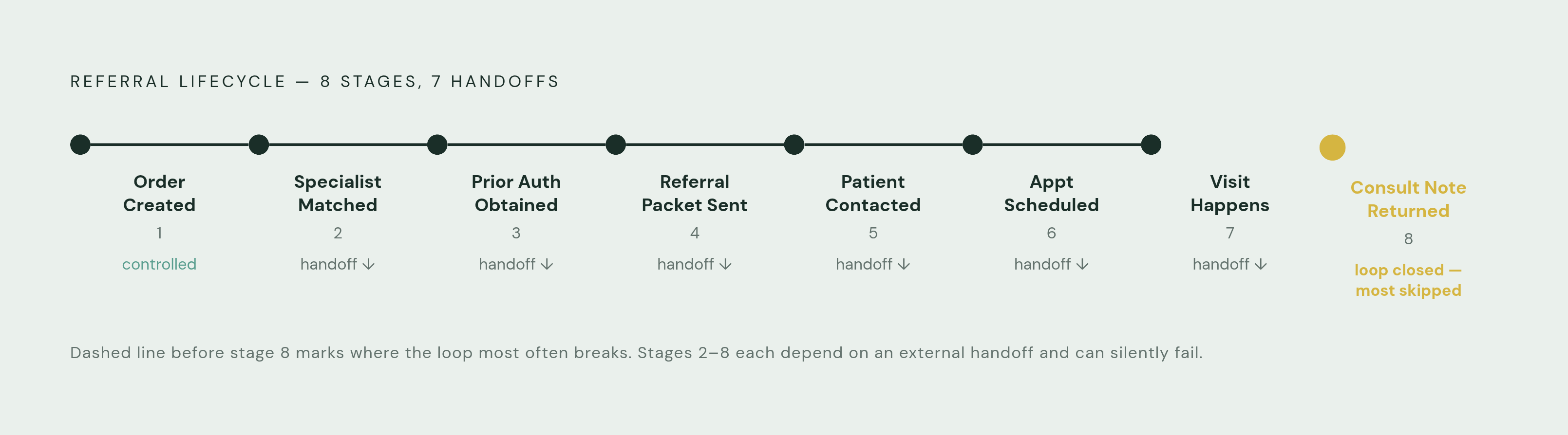
Treating a referral as a single event, the act of one provider sending a patient to another, misses most of where it can fail. A referral is better understood as a lifecycle with eight distinct stages: the order is created, a specialist is matched, prior authorization is obtained, a referral packet is sent, the patient is contacted, an appointment is scheduled, the visit happens, and a consult note is returned to the referring provider.
Manual coordination tends to hold at the first stage, because creating an order is usually one provider's action inside a system they control. Every stage after that depends on a handoff, and each handoff is a place where human follow-through can simply not happen. A referral fax that fails silently, arrives with missing pages, or lands in a queue no one is actively checking is lost the moment that happens, well before anyone notices, because staff cannot act on a document whose existence they don't know about.
The eighth stage, the consult note returned to the referrer, gets treated as the most optional part of the process, which is backward, since it's the only stage that actually closes the loop for the referring provider and tells them whether the referral did anything. Without it, a referring clinician has no way to know if a patient they sent to a specialist three weeks ago ever arrived, was ever seen, or ever received a diagnosis.
Virtual integrative settings stretch this eight-stage chain even further. Specialists in these networks are often spread across geography, not co-located in one clinic or hospital system. Many run on EMR platforms built for narrative notes and functional medicine frameworks, not for standardized data exchange, and the licensure rules they follow often diverge from the rules that apply to conventional telehealth. Every one of those three conditions adds friction to a lifecycle that was already fragile in traditional care.
Referral leakage is a workflow failure, not a patient behavior problem
When a referral never becomes a completed visit, most healthcare leaders default to blaming the patient: they didn't call, they didn't show up, they lost interest. The actual cause usually sits upstream, in the handoff stages of the lifecycle, long before the patient had a chance to act.
The mechanism is simple to describe. When a referral decision is communicated verbally rather than entered into a system, it becomes invisible to everyone downstream. A coordinator can't track a decision that was never recorded. If a patient's arrival was never confirmed, the specialist can't prepare for it. A referring provider gets no signal when the handoff fails, because as far as the system is concerned, nothing happened.
A quality improvement study published at a tertiary hospital put a number on this invisibility. Before a structured, EMR-embedded referral order was introduced, fewer than two inter-clinic outpatient referrals per week were formally recorded, despite high outpatient volumes and frequent cross-specialty clinical handoffs. That low number did not reflect low referral activity. It reflected a system where referral decisions were made verbally and never entered anywhere that could be counted.
After the structured order was introduced, documented referrals rose fast and held at a mean of more than 800 referrals per week over the following 35 weeks. That volume of referral activity had been present in clinical practice the entire time. It simply had nowhere to register until the system gave it one.
Virtual integrative settings face a sharper version of this same problem. Many practitioners work solo or in small groups, on platforms that connect to neither payer infrastructure nor hospital systems. There is no shared system for a referral to disappear into, because there was never a shared system to begin with, so the referral does not exist operationally from the moment it's made. Reducing leakage, then, is not a matter of reminding patients to follow up after a referral has already gone quiet. It requires making the referral visible to a system at the moment it's created, before the patient has to do anything.
Prior authorization is the lifecycle stage most likely to stall a virtual integrative referral
Of the eight stages, prior authorization is the most likely to stall a referral outright, and the regulatory ground under that stage is shifting fast. The CMS Interoperability and Prior Authorization Final Rule, CMS-0057-F, took effect in January 2026, and it is the most significant recent change to this part of the lifecycle. Under the rule, every denial must now come with a specific, stated reason, so a payer can no longer reject a request with no explanation attached. By March 31, 2026, payers must publicly report their approval rates, denial rates, appeal overturn rates, and average response times. Payer performance on prior authorization becomes comparable across providers for the first time. A further mandate lands January 1, 2027: payers must stand up a FHIR R4-based Prior Authorization API capable of handling electronic requests, flagging documentation requirements, and returning approval or denial decisions, complete with specific reasons for any denial.
A separate CMS program, the Wasteful and Inappropriate Service Reduction Model, or WISeR, launched January 1, 2026 as a six-year pilot through the CMS Innovation Center, running through December 31, 2031. It applies only to traditional Medicare fee-for-service, not Medicare Advantage, and only in six states: Arizona, New Jersey, Ohio, Oklahoma, Texas, and Washington. WISeR uses AI and machine learning to screen prior authorization requests, but a licensed clinician still has to review every denial before it stands. The model is voluntary on paper, but functionally close to mandatory: claims for the services it targets, submitted without prior authorization, go straight into prepayment review instead.
For virtual integrative practices, the clock that matters most is the one ending January 1, 2027. If a platform doesn't build toward FHIR compliance now, it will lose prior authorization coordination capacity to larger systems that are already building it, and the cost of handling PA manually will keep climbing under the new reporting and denial-reason requirements.
What closed-loop referral design looks like in practice
A closed referral loop is a workflow in which the system itself, not a patient left to call a specialist's office and not an individual coordinator trying to remember who owes a follow-up, carries the referral from order creation through to the returned consult note. Each stage triggers the next automatically, through a structured, documented handoff. Open loops default to failure because they put the burden of continuity on human memory at exactly the points where memory is least reliable: busy clinics, distributed teams, and handoffs between people who don't work in the same building or even the same organization.
Cleveland Clinic's Ambulatory ED Expected Arrival Order shows what this looks like at the order-creation stage. Before the change, stable patients referred to the emergency department often arrived with no completed note and no clear account of why they'd been sent, and gaps in communication and delays in care followed from that. ED teams found out a patient was coming only when the patient walked in, with no advance knowledge of the reason for referral and no clear way to reach whoever had sent them. The fix embedded referral communication directly into the EHR: ambulatory providers now place a structured order in the patient's chart specifying the reason for referral, the preferred ED destination, anticipated admission needs, and how to reach the referring provider. An alert fires at triage the moment the patient arrives, showing who referred them, why, and how to contact that provider, and the alert stays visible as the patient moves through the department. Adoption was fast: more than 300 orders were placed in the first two weeks, and early data showed referred patients admitted at higher rates than walk-ins, giving the hospital upstream information it could use for bed planning and routing. Cleveland Clinic's team has said it intends to extend this same integration to virtual care and other points of access.
The January 2026 quality improvement study demonstrates the other half of the lifecycle, patient outreach and appointment scheduling. Embedding a standardized inter-clinic referral order into the EMR at the close of a visit triggered immediate, real-time action from a centralized referral coordination team, turning the referral from a verbal instruction into an event the system itself acted on. That team reached most referred patients within nine minutes of the referral being entered, so the patient no longer had to initiate contact, which is what defines open-loop referral processes. Of all referrals logged, nearly three quarters ended in a completed next step, whether a scheduled outpatient appointment, same-day access, or direct admission. None of this required new technology. It required treating the close of a visit as a clinical and operational handoff.
Both cases share the same underlying mechanism: the referral order becomes a system event the moment it's created, triggering the next stage automatically rather than waiting on a person to notice it and act. Virtual integrative settings need this mechanism built in deliberately, because no single EHR environment spans every discipline involved. The boundary between disciplines is also a boundary between systems, and nothing crosses it unless someone designs for it to.
Where teleconsultation eliminates unnecessary referrals before the lifecycle begins
Not every referral that enters the eight-stage lifecycle needed to be there. Some represent nothing more than clinical uncertainty that a short specialist teleconsultation could have resolved without any physical handoff. A portion of referral volume, and the leakage risk that comes with it, is avoidable before the lifecycle even starts.
The multidisciplinary integrated telehealth platform at Taichung Veterans General Hospital, deployed across institutions in central Taiwan, shows this mechanism working at scale: a brief consult between providers can resolve a clinical question that would otherwise have triggered a full referral.
Virtual integrative care is particularly well suited to this kind of upstream triage, since the model already runs on telehealth infrastructure. A short cross-disciplinary exchange, say between a primary care provider and a functional medicine specialist, can settle whether a full referral, with all the prior authorization, packet assembly, and scheduling that entails, is actually warranted. When you design workflows for virtual integrative referrals, you need a formal pre-referral teleconsult stage ahead of the eight-stage lifecycle, with tighter management of the eight stages once a referral has already been created.
The interoperability gap that makes integrative-specific platforms both necessary and risky
Functional and integrative medicine practices need EMR systems built around narrative notes, customizable chart templates, and clinical frameworks specific to functional medicine. Those same customization needs run directly against the standardized FHIR-based data exchange that closed-loop referral coordination depends on, which puts the clinical and the coordination requirements of these practices in tension with each other.
Platforms built specifically for this space, OptiMantra among them, serve functional, integrative, and wellness clinics with customizable chart templates, scheduling, lab integrations, built-in telehealth, and patient engagement tools. These platforms support the clinical workflow well, but they face the same FHIR compliance obligations under CMS-0057-F as any larger health system, and they have far fewer engineers to meet the January 2027 deadline.
The interoperability gap in integrative care runs wider than in conventional settings for structural reasons. Many practitioners work solo or in small groups, without the IT infrastructure that a system like Cleveland Clinic can draw on to build EHR-embedded referral workflows. Difficulties already documented in virtual care implementation, including a lack of integrated systems, too few professionals, and long response times, compound further in smaller integrative practices where staff have limited capacity for manual coordination to begin with.
A second risk sits in the instability of telehealth policy itself. The network of specialist endpoints a virtual integrative referral workflow depends on can shrink with regulatory shifts, so investing in workflow infrastructure built around a provider network that may not hold together is a real operational exposure. If a practice operates outside value-based contracts, it has little financial reason to build closed-loop referral infrastructure, because the cost of leakage lands on patients and on downstream systems, not on its own revenue.
Sources
- Tech-driven ED Referral Tightens Care Coordination
- Healthcare Integration Types and Strategies for 2026
- Improving Referral and Continuity of Care Through Structured Outpatient Disposition Planning Enabled by Electronic Referrals: A Quality Improvement Study - PMC
- Referral Leakage: Why Half Your Referrals Never Become Appointments - HealthTalk A.I.
- Closing the Loop A Guide to Safer Ambulatory Referrals in the EHR Era