Patient Portal Adoption Rates and Documentation Completeness
Hospitals built patient portals, but most patients still aren't using them consistently.

Hospitals finished building the digital front door years ago. Patients still aren't walking through it consistently, and the record of what's actually inside their charts faces documented questions about completeness and accuracy. That gap between infrastructure and use is the story of patient portals in 2025, and it's a story with real consequences for how accurate, current, and trustworthy the American medical record actually is.
What patient-side adoption numbers actually show
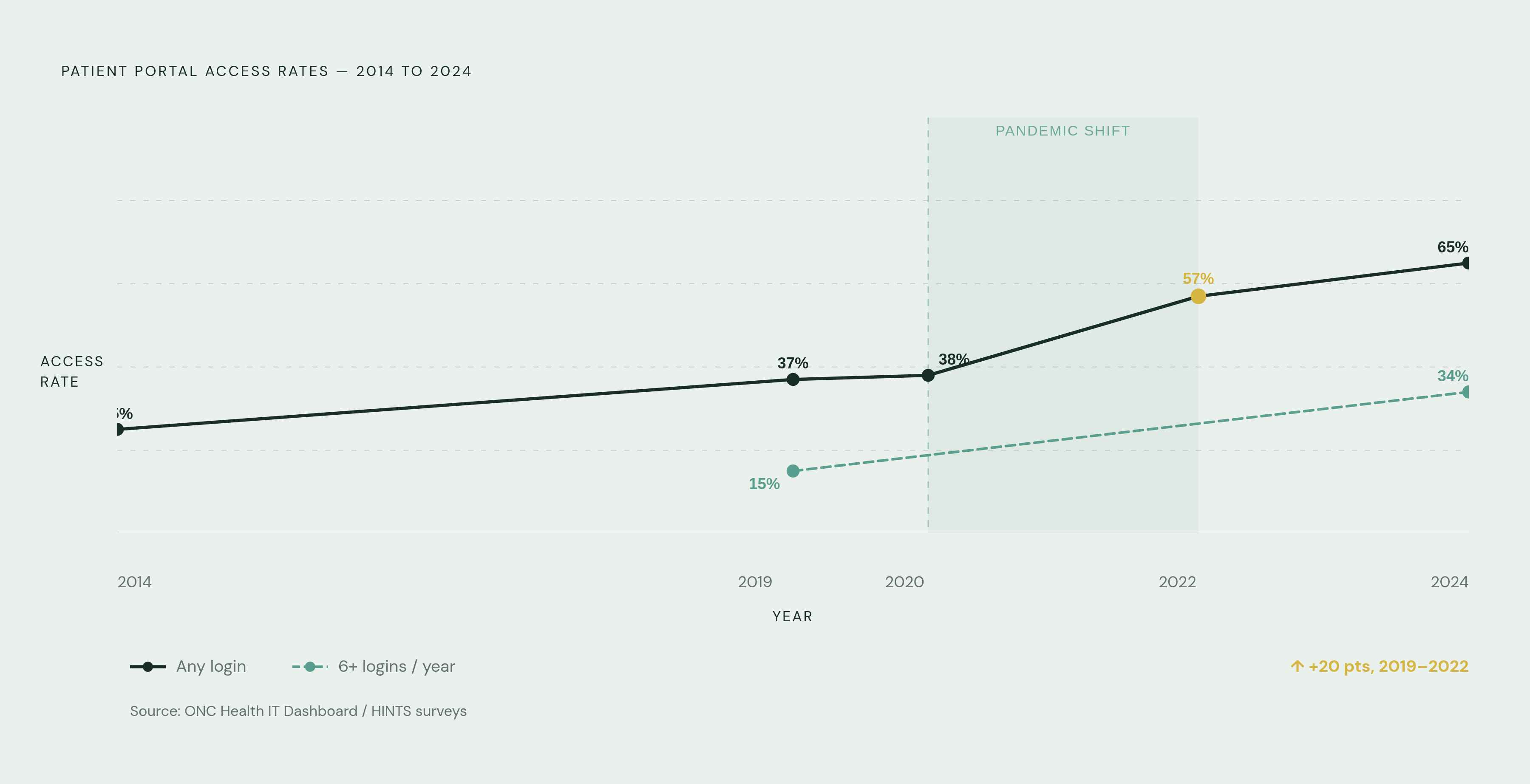
Start with the offer rate. As of 2024, 77% of patients were offered access to a portal, and of those offered, 65% logged in at least once, according to ONC data drawn from the Health Information National Trends Survey. Multiply those two figures against the full patient population and the compounding gap becomes obvious: most patients have an available account, but a meaningful fraction never open it.
The trend line is real, though. Offer rates sat at just 42% in 2014; access rates have more than doubled since then, climbing from 25% to 65% over the same decade. Pre-pandemic, only 37% of Americans had ever accessed a portal, as of 2019. Then a global public health crisis hit, and use jumped to 38% in 2020, then 57% by 2022, then 65% by 2024. That deviation exceeds the range of a blip. It's a structural shift in how patients relate to their own records.
Frequency tells a parallel story. The share of patients logging in six or more times a year doubled, from 15% in 2019 to 34% in 2024, which marks a shift from one-time sign-up to something closer to habit. Chronic disease and cancer populations outpace the national average by a wide margin: roughly 70% of chronically ill patients used their portal when offered, and 76% of those managing a recent cancer diagnosis accessed their records. Caregiver and proxy access has grown substantially over the same period, a dimension that national topline figures tend to bury.
None of this means engagement runs deep. Median patient digital engagement score, measured across all portal activities, sits at just 14 out of 100. Enrollment is not use. Use is not depth. That 14-point median is arguably the single most important number in this entire picture, because it's the number that shows the supply-demand gap hasn't closed. It's just moved.
How patients are accessing portals, and what the mobile shift means for engagement
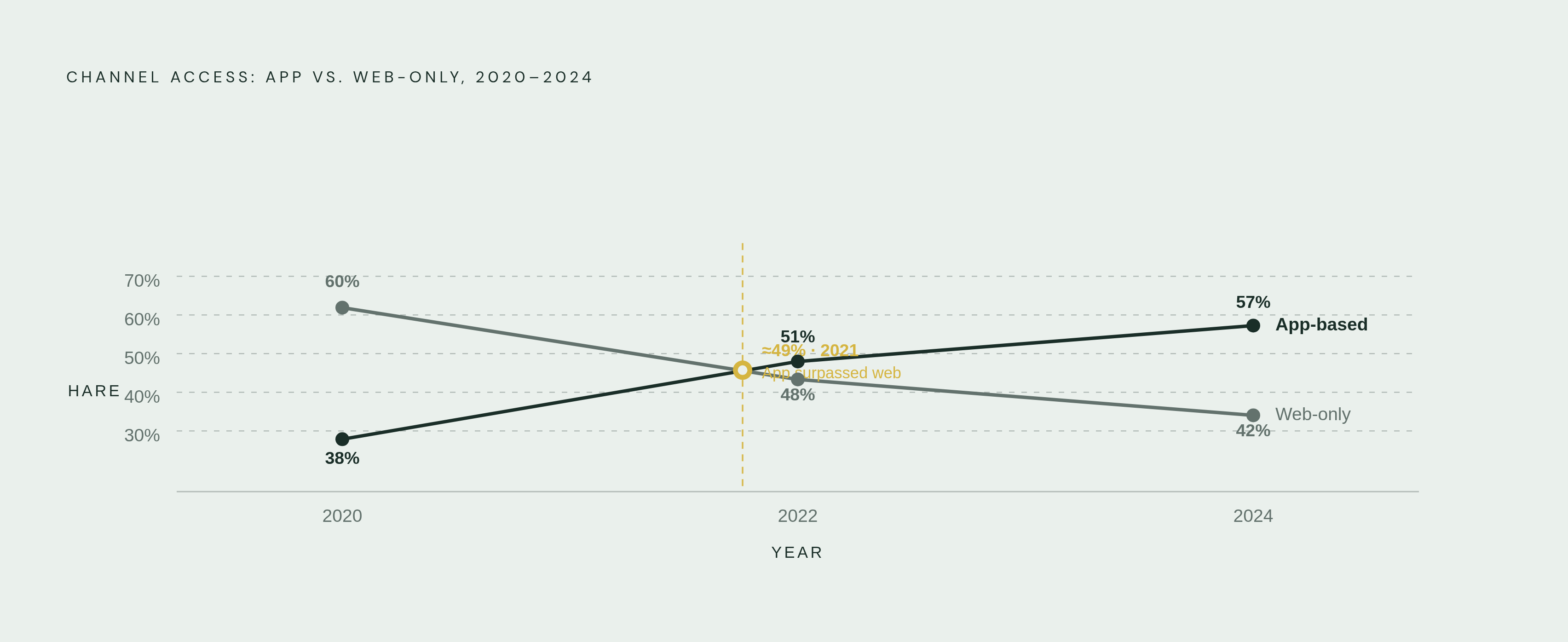
The channel has changed underneath the numbers. App-based access reached 57% of individuals in 2024, up from 51% in 2022 and 38% in 2020. Web-only access has fallen in lockstep: 60% in 2020, 48% in 2022, 42% by 2024. The crossover already happened. Mobile is not a secondary channel anymore, it's the primary one, and that has design consequences that hospitals and health systems can't treat as cosmetic. Mobile-optimized portals see adoption rates 40% to 60% higher than desktop-only interfaces. A portal that renders poorly on a phone screen is, functionally, a portal that a growing share of patients will simply not use.
Fragmentation compounds the problem. In 2024, 59% of individuals nationally managed access to multiple portals or online medical records, a natural byproduct of seeing more than one health system, specialist network, or urgent care chain. Only 7% used any kind of portal-organizing app to bring those accounts together. That means a patient's actual medical history, spread across two, three, or four separate logins, almost never lives anywhere in one consolidated view, not even in the patient's own hands. For documentation completeness, that's a serious structural weakness: the portal a patient checks most often may capture only a fraction of their real care history, and no one, not the patient, not the provider, not the hospital's own EHR, sees the whole picture in one place.
Who is not logging in, and why the gap is not random
Activation isn't evenly distributed, and the pattern behind it is worth sitting with. The single strongest individual predictor of activation is whether a patient has an email address on file, which functions less as a clinical signal and more as a proxy for digital literacy and reliable connectivity.
Gender shows a gap too: men are 16% less likely than women to activate a portal account. Age shows gaps at both ends of the spectrum. Patients aged 0 to 20 activate at only 13% to 16%, and activation among patients over 90 drops to 24%. Portal use among adults over 65 runs well under the national average.
Race and language carry the sharpest disparities. Portal use among Black patients runs meaningfully below the national average, and it's lower still among non-English speakers. Ward-level data out of Washington, DC shows non-Hispanic White patients activating at substantially higher rates than non-Hispanic Black patients in the same city, and that gap held even in analyses restricted to recent encounters. It held within individual wards too, regardless of the ward's socioeconomic profile, which rules out the easy explanation that neighborhood resources alone are driving the divide.
Geography plays a role on the supply side as well. ONC and ASTP data flag small, rural, non-teaching, critical access, and independent hospitals as less likely to enable certain portal capabilities in the first place, meaning some of this gap is not patient behavior at all, it's incomplete deployment. And even where onboarding succeeds, it doesn't always stick: a 2025 meta-analysis found about 55% of older adults had used a portal at least once, but only 49% remained continuing users, with wide variation across studies. Improved onboarding alone didn't sustain engagement. Ongoing tech support did.
The pattern behind this runs on identifiable causes worth underlining. The patients least likely to have a complete portal record, older adults, non-English speakers, Black patients, rural patients, are disproportionately the same patients managing complex or undertreated conditions. The digital divide in portal adoption tracks almost exactly onto the populations where documentation completeness matters most.
What the 21st Century Cures Act required of clinical documentation
Congress didn't leave this entirely to hospital discretion. As of April 5, 2021, the information blocking rule under the 21st Century Cures Act required that eight categories of clinical notes generated in an EHR be made immediately available to patients through a secure online portal. Providers, individual or organizational, are barred from blocking or delaying access to eligible information, including test and study results, once it's entered and stored in the record. Violations carry teeth: the relevant federal oversight authority can impose substantial financial penalties per confirmed instance of information blocking.
The scope has only widened since. On October 6, 2022, the definition of electronic health information under the Act expanded, broadening what providers are obligated to release. And the regulatory floor keeps rising: the HTI-4 Final Rule, finalized in July 2025, sets new certification requirements around real-time prescription benefit checks and electronic prior authorization. Real-time prescription benefit checks become a mandatory "Base EHR" capability by January 1, 2028. Electronic prior authorization starts getting measured under Medicare quality programs in 2027, though it hasn't yet been folded into the Base EHR definition itself.
Hospitals responded fast on the notes front. More than four out of five hospitals offered patients access to clinical notes through a web-based portal as of 2021, and growth continued from there. But passing a law that requires access is not the same as guaranteeing that access gets used, or that what's available is complete, timely, and actually legible to the patient reading it. That separate question is the one that matters more going forward.
How the Cures Act changed patient behavior around clinical records
The mandate did move patient behavior, and the numbers are hard to argue with. At health systems that implemented open notes, engagement climbed after the mandate took effect but leveled off well short of universal use, with sociodemographic variation that echoes the activation gaps described above almost exactly.
Health system data from the years surrounding the mandate tells a sharper story. Before the Cures Act requirement took effect, only a small share of patients reviewed their test results before their own clinicians did. After the mandate, that share rose substantially. For results that had previously been held back under delayed release policies, the shift was even starker: patient review rates rose sharply once the delay was removed.
That's latent demand made visible. Patients want to see their results, and when the barrier comes down, they show up. But the plateau matters just as much as the jump. An engagement ceiling well below universal use, alongside persistent variation by demographic group, says that removing the access barrier is necessary but nowhere near sufficient. A meaningful share of patients, even with results sitting one click away, still never open them.
That has stakes beyond convenience. Documentation completeness is now, in part, a patient-side outcome: a patient who actually reads their chart can catch a wrong medication list, flag a missing allergy, or push for a correction that a busy clinician might otherwise miss. But only if they log in and look. Research on malpractice cases has consistently linked a significant share of adverse outcomes to documentation failures. That inefficiency carries concrete costs. It's a liability exposure sitting inside a record nobody's reading closely enough.
Active portal use and its effect on EHR data completeness
Active use appears to improve record completeness, but unevenly. In chronic disease settings, patients who engage with their portals tend to flag missing or incorrect information, partly because known disease indicators make gaps easier to spot in the first place. A patient managing a chronic condition and checking their key health metric trend will notice a missing medication far faster than a healthy patient glancing at a single annual visit summary. Outside chronic disease, and across provider types where disease markers are less discernible, that completeness effect gets noticeably less consistent.
That unevenness creates an awkward mismatch. The patients most likely to improve record quality through active engagement, chronically ill patients who log in often, are not the same patients whose records are most likely to carry gaps in the first place. Low-activation, digitally underserved patients, the ones flagged in the disparities above, are exactly the group least likely to be the ones catching and correcting errors.
Fragmentation makes the completeness problem worse still. With 59% of patients juggling multiple portals in 2024, and only 7% using any tool to consolidate them, no single EHR holds anything close to a full picture of most patients' care. And the one portal function built specifically to let patients fix their own records, the "amend" feature, has also been the most stagnant category in hospital-side adoption over the past decade, per the AHA survey trends. The least-used tool on the hospital side happens to be the one most directly tied to completeness. That coincidence warrants closer scrutiny rather than being glossed over.
Doubling the six-plus-logins-a-year cohort from 15% to 34% between 2019 and 2024 is genuine progress. It's just progress that still leaves most enrolled patients as low-frequency users, checking in occasionally rather than tracking their record as a living document.
Interventions that have moved activation rates for underserved populations
Some programs have actually closed the gap, and they share a common design principle: they attack a specific barrier rather than assuming patients simply lack interest.
UCSF's approach automatically enrolled patients and followed up with text-message offers starting in March 2020, studied specifically for its effect on activation rates by race, ethnicity, and primary language. The program was framed internally as a "techquity" intervention, aimed squarely at structural barriers rather than patient motivation.
A Digital Access Coordinator program deployed 12 multilingual navigators across a primary care network covering 1.25 million patients and 1,211 clinicians. Between May 2021 and November 2022, those coordinators completed outreach to 16,045 patients and successfully enrolled 8,193, a 61% success rate among the 13,413 patients they actually reached. That's a model built around relationship, not technology, meeting patients where the barrier actually sits: language, trust, or simple unfamiliarity with the process.
The older-adult research confirms a related point. Onboarding alone isn't the fix. The 2025 meta-analysis found that sustained engagement required ongoing tech support, not a one-time enrollment event. And mobile-optimized design, the 40% to 60% adoption lift mentioned earlier, functions as an intervention in its own right, even though it's a design choice rather than a staffed program.
What none of these interventions answer yet is whether higher activation actually produces more complete records. Enrollment and record quality may still be loosely coupled even after a patient successfully logs in for the first time.
Federal funding uncertainty and the risk of a hardening digital divide
The policy environment took an odd turn in 2025. Federal officials issued a BEAD Restructuring Policy Notice in mid-2025, requiring states to revise their Broadband Equity, Access, and Deployment Program proposals. Around the same time, Digital Equity Act awards were cancelled for a number of previously recommended projects, including several with a specific health focus.
Stakeholders have raised a direct concern: these changes risk hardening the digital divide rather than narrowing it. Broadband is not a side issue for portal adoption, it's the precondition for it. A patient without reliable connectivity cannot log into a portal regardless of how well-designed the app is or how many navigators a health system hires.
The timing creates a genuine contradiction. The HTI-4 Final Rule is pushing the technical floor for EHR capability upward through 2028, while the funding meant to extend connectivity to rural and low-income patients is being pulled back in the same year. Hospital-side capability keeps climbing. Patient-side access for the most underserved populations is becoming less certain, not more, and that's a widening that has nothing to do with design or motivation. It's a widening driven by who has broadband and who doesn't.
That's the policy dimension of documentation completeness that rarely gets discussed alongside the clinical one. A patient who can't reliably get online cannot review a note, cannot flag an error, cannot amend a chart, no matter what the Cures Act obligates a provider to make available on the other end.
Where the market is heading and what the growth figures obscure
Global patient portal market figures, the kind that show up in industry reports projecting steady multi-year growth, tell an accurate story about vendor revenue and hospital procurement. They tell a much thinner story about what's actually happening at the point of care.
Growth in market size reflects continued investment in infrastructure, more health systems buying and upgrading portal software, more functionality bundled into EHR contracts, more certification requirements pushing vendors toward compliance. Those effects add up to something. But market growth curves and patient engagement curves are not the same curve, and conflating them is the easiest mistake to make in this space. A portal market can expand steadily for a decade while median patient engagement scores sit in the teens, and both of those facts can be true at once.
The honest read on where this heads is that hospital-side infrastructure will keep maturing, largely because regulation keeps ratcheting the floor upward regardless of demand. Patient-side use will keep climbing too, on the back of pandemic-era habit formation and continued app adoption. But the populations least likely to benefit, older patients, non-English speakers, Black patients, rural patients, patients without reliable broadband, are the same populations flagged across every section of this data. Closing that gap will take more than better software. It will take navigators, sustained tech support, and, increasingly, a broadband policy that doesn't work against the goal it claims to serve.