Integrating Remote Patient Monitoring Data Into EHR Notes
Clinicians need device data structured in their EHR, not just transmitted to it.
Remote patient monitoring has stopped being a pilot program and become standard practice. Clinician adoption hit 81% by 2023, up substantially from earlier in the decade, and none of that volume matters if the data never reaches a clinician in usable form. That's the actual bottleneck, and it's the wrong place for the industry to keep looking away from. RPM only changes outcomes when device data lands inside Epic, Cerner, or whatever system a clinician already trusts, and too many programs get bolted onto workflows that were fragmented before the monitoring started.
Solving that requires three separate layers: a technical pipeline that moves data into the record, alert and summarization logic that makes it legible, and a documentation workflow that decides whether a clinician ever acts on it. Most programs only ever build one of the three. Skip a layer and the effort produces another dashboard nobody opens. The industry's instinct, when RPM fails to move outcomes, is to buy more sensors and more dashboards. That instinct is backwards. The failure sits upstream, in plumbing and triage logic nobody wants to own, and no amount of additional hardware fixes a problem that lives in data formatting and alert fatigue.
What moving device data into an EHR actually requires at the technical level
Getting a blood pressure cuff or a cardiac implant to talk to an EHR is not a plug-and-play exercise. It means aligning data formats, workflow expectations, and compliance requirements across systems that were rarely designed with each other in mind. Much of the friction comes down to something mundane: different RPM platforms structure their data differently, so even when both systems are technically capable of sending and receiving information, the exchange doesn't come out clean on the other end.
That distinction, between sending data and actually understanding it, deserves close attention. Interoperability researchers split it into foundational interoperability, where one system can transmit information to another, and semantic interoperability, where the receiving system can interpret that information and act on it without a human translating in the middle. Most healthcare organizations have solved the first problem. Few have solved the second, and that's the one that actually determines whether the data gets used. In practice, the gap shows up as clinical data arriving in the EHR as an unstructured PDF, or as a code the receiving system has no idea how to parse. A nurse or medical assistant then re-enters what the device already transmitted, by hand, every day. That re-entry step is where most RPM programs quietly die, not from a lack of data but from the labor cost of translating it manually on a loop.
A study out of Geisinger, presented at AMIA in 2025, shows what's at stake when the pipeline works as intended. Combining RPM data, body weight, blood pressure, blood oxygen, with existing EHR data improved the ability to predict ED visits and unplanned hospital admissions beyond what either data source could do alone, in a cohort of 913 patients. That's the upside case. The downside case, and the far more common one, is a monitor generating readings all day that never inform a single clinical decision because nobody built the bridge between the device and the chart.
How FHIR and HL7 standards shape what integration is actually possible
FHIR, the HL7 standard for exchanging electronic health information, exists to give every system a common way to represent patient data regardless of how that data is stored internally. It's mandatory for certified health IT developers and payers under the 21st Century Cures Act and the CMS-0057-F rule, so even providers without a direct mandate encounter it as the de facto standard the moment they touch a certified EHR or a payer system.
FHIR is the right call for anything built new, and there isn't much of an argument against it: it carries modern technical support and regulatory backing, while building fresh integration work on HL7 v2 today means building on a standard the industry has already voted to retire. That said, HL7 v2 remains firmly entrenched for now. It's baked into the legacy infrastructure of hospital systems that have run on it for decades, which means most real-world integration projects end up managing both standards at once rather than picking a side.
Standards alone don't close the gap, and treating FHIR adoption as the finish line is a mistake. In practice, FHIR adoption still runs into terminology mapping issues, inconsistent implementations across vendors, and scalability limits, all of which demand manual mapping and data transformation before a deployment works as advertised. A FHIR-compliant EHR sitting next to a FHIR-capable RPM platform does not guarantee the data landing in the chart is structured well enough for a clinician to act on without extra processing in between.
The platform choices that determine how much custom work integration requires
Two broad paths exist here: the native EHR module, where RPM data ingestion happens inside the system clinicians already use, and the third-party integrator, which sits between the devices and the EHR and does the translation work independently. Anyone choosing between them should stop looking for the option that avoids trade-offs, because it doesn't exist.
Epic's approach runs through MyChart, which pulls in patient-generated health data via Apple HealthKit or connected consumer devices and shows clinicians the resulting trends, a model sometimes called "deviceless" RPM because it skips proprietary hardware. Getting custom workflows approved inside Epic, like feeding device data directly into a patient's flowsheet, usually means working through hospital IT on a timeline that isn't fast. Still, Epic is widely recognized as a leading platform for virtual care integration. Oracle Cerner runs a comparable model through its CareAware platform, which enables RPM data flows into its EHR environment.
Outside the native EHR vendors, Lightbeam Health's deviceless RPM offering topped KLAS ratings in 2024 and 2025 by aggregating patient-reported metrics without proprietary hardware, leaning on population health analytics to flag at-risk patients. Validic takes a more device-agnostic route, integrating directly with both Epic and Oracle Cerner and connecting with a broad range of consumer and clinical health devices to bring patient-generated data into existing clinical workflows.
The tension across all these options is consistent, and there's no engineering around it. The more customizable an integration is, the more it demands from hospital IT. The more out-of-the-box a solution is, the less likely it fits a specialty's particular workflow. Cardiology makes this especially visible: a 2024 HRS Perspective published in Heart Rhythm O2 documents an entire ecosystem built around cardiac implantable electronic devices, with manufacturers, data aggregators, and workflow vendors each handling the handoff to the EHR differently. There is no single universal answer here, and anyone selling one hasn't had to actually build the integration.
Why the volume and accuracy of alerts determines whether clinicians use the data at all
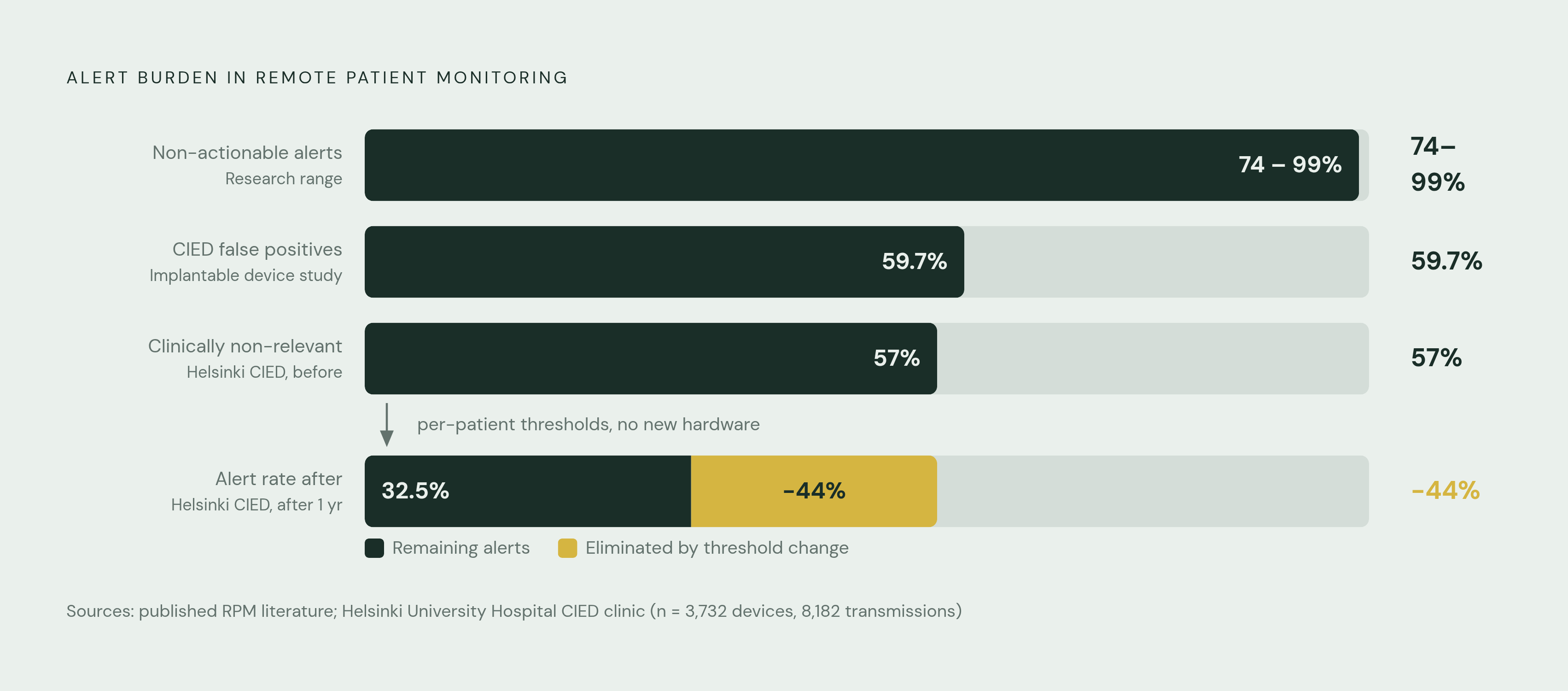
None of the plumbing matters if what comes through the pipe is mostly noise, and this is where most RPM programs actually lose clinicians, not at the integration stage. Published research on physiological monitor alarms puts the share of non-actionable alerts anywhere from 74% to 99%, depending on the monitoring context and how the device is configured. In remote monitoring specifically, false positives make up a large share of what gets transmitted: one study of implantable device monitoring cohorts found 59.7% of alerts were false positives.
Helsinki University Hospital's CIED clinic shows what that means at scale. Across 8,182 transmissions from 3,732 devices in 2023, 57% of alert transmissions turned out to be clinically non-relevant. After the clinic adjusted alert settings on an individualized, per-patient basis, the overall alert rate dropped 44% between January and December of that year.
The consequence of ignoring this problem compounds rather than sits still. When a high share of alerts are non-actionable, clinicians respond more slowly to the alerts that matter, override rates climb, and the cognitive load of sorting real signal from noise eats into time that should go toward clinical judgment. Helsinki's result matters less as a specific benchmark and more as proof of a mechanism: the variable that moved outcomes wasn't a smarter algorithm, it was replacing device-default thresholds with individualized ones. That's the piece most vendors skip, because tuning per-patient thresholds is slower and far less demoable than shipping a new dashboard.
How alert logic and summarization can filter noise before it reaches the clinician
Fixing the alert problem comes down to three approaches: setting thresholds individually per patient and device, tuning at the population level, and building automated triage that routes non-urgent transmissions to asynchronous review instead of interrupting a clinician in real time. Of the three, individualized per-patient thresholds are the one with actual evidence behind them. Helsinki's 44% drop came from individualized alert setting adjustments, replacing device-default thresholds with per-patient ones, demonstrating what that approach can achieve within a single year. Health systems investing in platforms that refine alerting and automate prioritization are, in effect, trying to buy back clinician attention rather than adding more data to the pile.
Research on EHR use links information overload directly to missed critical findings, clinical errors, and delays in care delivery. Summarization logic exists specifically to counter that risk, and the mechanics of doing it well look similar across platforms: aggregate trends over a defined window instead of pushing every individual reading, flag deviation from a patient's own baseline rather than a generic population threshold, and generate a structured summary, a seven-day weight trend, a blood pressure trajectory, a pattern of missed readings, that a clinician can scan in seconds instead of parsing line by line. Genuinely abnormal findings still trigger a real-time alert. Everything else goes into a queue for scheduled review.
The Geisinger cohort mentioned earlier used a version of this that's still largely manual: rule-based alarms flagged out-of-range vitals, which triggered a nurse case manager to make contact. That's the triage layer functioning without AI summarization on top of it, and much of the industry still runs on exactly that model. Even a well-filtered alert stream and a clean trend summary still require a clinician to sit down, read it, and decide what to do, which is where the problem shifts into documentation.
Where ambient AI documentation connects RPM data to the clinical note
Physician use of AI tools in clinical practice nearly doubled in a single year, from 38% in 2023 to 66% in 2024, and ambient clinical documentation has become the clearest expression of that shift. By June 2025, 62.6% of Epic hospitals had adopted ambient AI documentation, and among practices already using AI tools, 72% rely on an ambient scribe as their primary application. At least 60 vendors now compete in this space, all offering some version of the same core function: capture the audio of a visit and turn it into a structured draft note inside the EHR.
The connection to RPM is direct, if underappreciated. An ambient tool captures the whole clinical encounter, including whatever the provider says out loud about a patient's monitoring trends, and turns that verbal interpretation into part of the note automatically. If RPM summary data is already on screen during the visit, and the provider references it out loud, that reference gets folded into the draft note without anyone typing it in by hand. Ambient tools commonly connect with major EHR platforms through browser extensions, mobile apps, or dedicated in-room microphones.
A deployment at Geisinger, evaluated through October 2025, illustrates the mechanism concretely. Pharmacists activated ambient recording during patient interactions, and Abridge's large language model converted the voice-to-text data into a structured clinical note draft inside the EHR in real time. Clinicians still had to review, edit, and approve every draft before it became part of the permanent record, and that step matters: none of this removes clinical judgment from the loop. It removes the manual transcription step that used to sit in front of it. Estimates put the documentation time saved by ambient tools as high as 75%, and that figure matters less as a convenience metric than as the mechanism that makes reviewing RPM trends sustainable inside a normal visit length.
What the evidence shows about clinician outcomes when ambient documentation is deployed at scale
The clearest evidence comes from a pragmatic randomized trial run at UW Health between August 2024 and March 2025. Use of an ambient AI scribe correlated with a clinically meaningful drop in burnout scores, cut documentation time by 30 minutes per provider per day, and improved the accuracy of notes used for diagnosis billing. Roughly 800 physicians and advanced practice providers now use the technology across clinics and hospitals in Wisconsin and Illinois.
Other health systems report comparable gains. Other health systems have reported meaningful reductions in burnout prevalence and improvements in documentation-related well-being among clinicians using ambient documentation tools.
What these numbers show, and what they don't, matters here. They establish that ambient documentation meaningfully reduces clinician burden across health systems of very different sizes and specialties. They do not isolate remote monitoring data incorporation as the specific driver, since the measured gains come from reduced documentation burden broadly, not from any feature tied to RPM. The reasonable inference, though not a proven one, is that once ambient tools take the baseline documentation load off a clinician's plate, there's more cognitive room left to actually review and act on RPM trend data. That lowers the marginal cost of doing the work well, rather than eliminating it. Cardiovascular disease is the largest RPM application by market share, at 36.52% in 2025, which means the specialty carrying the heaviest CIED and continuous monitoring documentation burden is also the one where ambient tools face the highest bar to prove they can handle it.
How care teams need to change, not just the software
Every layer above depends on people, not just systems, and this is where most RPM strategy documents go quiet. A perfectly built FHIR pipeline, tuned alert thresholds, and an ambient scribe integrated into the EHR still won't produce better outcomes if the care team around them hasn't reorganized who reviews what, and when. Buying the technology is the easy part.
That means assigning clear ownership over RPM trend review, whether that's a nurse case manager, a pharmacist, or a rotating clinical team member, rather than assuming a physician will absorb another data stream into an already full visit. It means treating alert threshold adjustment as ongoing maintenance, the way Helsinki's clinic did, not a one-time setup task left to whatever the device shipped with. And it means training clinicians to trust, verify, and edit ambient-generated notes rather than rubber-stamping them on one end or ignoring the efficiency gain out of skepticism on the other, since both failure modes defeat the point of the tool.
The technology across all three layers, pipeline, alert logic, and documentation, has matured faster than the operational habits built around it. Closing that gap, not buying another sensor, is the work left to do.
Sources
- Integrating Remote Patient Monitoring Data into Machine Learning Models for Predicting Emergency Department Utilization
- Remote Patient Monitoring in the United States: 2025 Landscape Report | IntuitionLabs
- 2024 HRS perspective on advancing workflows for CIED remote monitoring
- Top 7 Ambient Listening AI Tools Revolutionizing Healthcare in 2025 - Security Boulevard
- arxiv.org
- med.wisc.edu