Scheduling Configuration for Group Medical Visits in Telehealth Platforms
Platforms need deliberate configuration to handle group visit scheduling at scale.
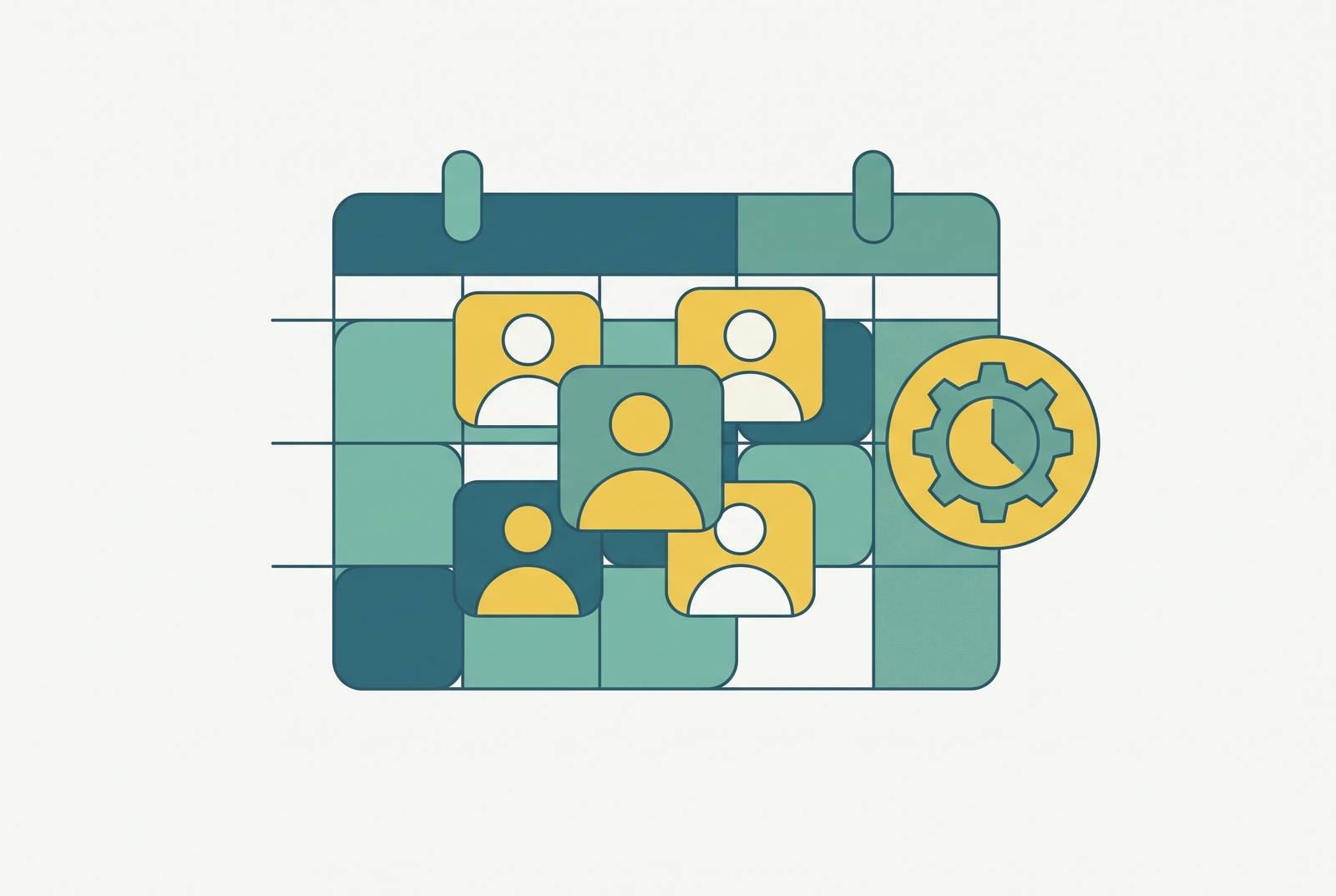
Group medical visits, formally called Shared Medical Appointments (SMAs), put several patients with the same chronic condition in a room, virtual or physical, with a care team on a recurring schedule. The scheduling engine behind a standard one-on-one telehealth visit was never built for this. It assumes one slot, one patient, one provider, and that assumption breaks the moment a program tries to run a hypertension group with multiple patients and more than one clinician rotating through individual check-ins. This piece walks through the configuration layers, from slot design to consent gating to billing codes to the policy calendar, that a program has to get right before the first group session goes live.
SMAs aren't loosely organized classes. They involve an interdisciplinary care team rather than a single clinician, a planned sequence of sessions rather than a one-off event, curriculum built around self-management education and peer support, and individual treatment review folded into the group's shared time. Virtual versions of this model started showing up in primary care as early as 2020, mostly aimed at hypertension and diabetes management delivered over secure video. Programs that stood these up had to solve medical-legal exposure, documentation standards, billing logic, and patient recruitment all at once. Scheduling was one part of a larger problem that also included medical-legal exposure, documentation standards, billing logic, and patient recruitment. It's one layer in a stack, but it's the layer that fails first and loudest if nobody configures it deliberately.
The clinical case that makes solving these scheduling problems worth the effort
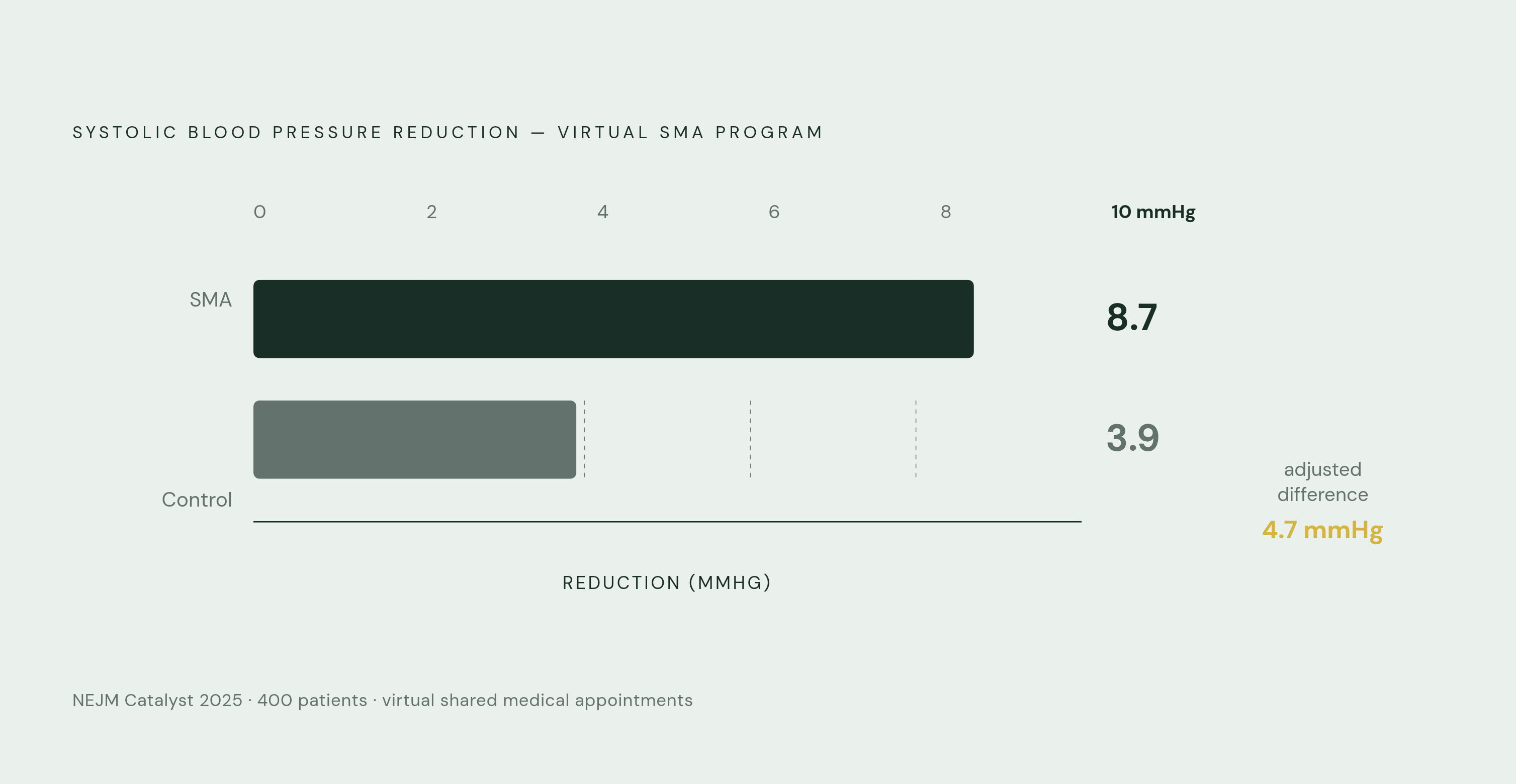
The outcome data justifies the engineering effort. A primary care SMA program tracked in NEJM Catalyst in 2025 enrolled 1,679 unique patients between March 2020 and October 2024. Within a cohort of 400 patients referred to a hypertension virtual SMA series, the group that went through the program saw systolic blood pressure drop by 8.7 mmHg, compared to a 3.9 mmHg drop in the control group, an adjusted difference of 4.7 mmHg. That's not a marginal effect for a condition where a few points of systolic pressure move cardiovascular risk meaningfully across a population.
The broader literature backs this up with improved patient satisfaction, faster access to care, and better communication, plus outcome gains documented across multiple chronic disease programs. Health systems have started framing SMAs around the Quintuple Aim: patient experience, population health, cost, provider wellbeing, and health equity. That's a lot of boxes checked by one care model, which is a big reason administrators keep greenlighting these programs even when the IT lift is nontrivial.
None of this reads as pilot-stage anymore. These programs are scaling, and scheduling infrastructure that was fine for a twenty-patient pilot starts breaking at ten times that volume if nobody rebuilt it to hold.
Schedule design as a clinical variable, not just an administrative one
Research on synchronous telehealth visits points to something practices tend to underweight: how a schedule gets built affects whether visits actually happen as video rather than degrading to audio-only, and whether they get completed at all. Clustering telehealth visits together on a provider's calendar, rather than interleaving them with in-person slots, cuts down on workflow friction. Alternating modalities all day creates switching costs for staff and can create workflow friction that works against the consistency remote patients need.
Group visits make this pressure worse, not better. A provider mid-session with eight patients on a hypertension group call can't just step out for a ten-minute in-person slot without derailing the whole group's flow. So block scheduling by modality becomes an operational requirement rather than a mere scheduling preference: providers running group visits need dedicated blocks reserved for that purpose, distinct from slots wedged between in-person appointments. Once that scheduling philosophy is settled, the next question is whether the platform actually has the features to execute it.
The platform feature set a group visit program requires
Every item below is a configuration decision a program has to make on purpose. None of it comes as a sensible default out of the box.
Multi-patient slot management has to hold and enforce a maximum enrollment number across the entire booking flow. Multi-provider room capability needs to let several clinicians join one video session as a real scheduling construct, not as an afterthought bolted on outside the platform's core booking logic. Group rooms need infrastructure separate from the one-on-one room setup, and availability needs to be customizable by provider and by appointment type rather than living on a single shared calendar.
Digital intake forms need to get collected inside the booking flow, before the session starts, so a patient has already completed them well ahead of arriving in the waiting room. Automated reminders by text and email matter more in group visits than one-on-one ones, because a no-show in a group session doesn't just cost that patient a visit, it affects the overall group experience for everyone else on the call. Browser-based, no-download patient access cuts dropout before the session even opens. And HIPAA compliance with a signed Business Associate Agreement is not optional anywhere in the stack, meaning the telehealth platform, the EHR, the scheduling tool, and any messaging layer all need one.
For more complex group formats, programs need the ability to add participants mid-session (a family member, an interpreter, a social worker, a specialist), screen sharing for education content, in-session messaging, and EHR access live during the call so a provider isn't toggling between systems while managing eight patients. AI-assisted scheduling shows up in some platforms now, helping match patients to available sessions and supporting more efficient referral pipeline management. That's most useful for programs managing large referral pipelines feeding multiple session types at once, less so for a single-condition group running once a week.
What to evaluate in how specific platforms handle group visit scheduling
Platforms differ on three things: whether group scheduling is native or bolted on as an add-on, how much configuration work falls on the practice, and how tightly the scheduling layer talks to billing and the EHR.
InSync runs group therapy sessions through its Patient Portal, with multiple providers able to join a single call from any device and one-click links for instant sessions. CareCloud's conference interface supports screen sharing, real-time messaging, and EHR access mid-session, paired with one-click scheduling from the EHR, SMS and email reminders, and calendar syncing for both sides of the appointment. Tebra lets patients self-book directly into the EHR calendar and sends intake forms digitally after booking but before the visit, with availability configurable by provider and appointment type; its telehealth layer covers group appointments alongside standard one-on-one virtual visits.
AdvancedMD gives administrators a provider list view showing every telehealth appointment across providers and locations from one screen, lets patients book against real-time availability, and sends reminders in a patient's preferred language; live sessions support adding participants and screen sharing. VSee runs on a no-code or low-code model, with queue management, scheduling, group calling, and payment processing all configurable, and clinicians reportedly able to add or adjust features in about a day without pulling in IT, which matters for practices still iterating on their group visit format. eVisit supports both one-on-one and group video formats, useful for chronic disease groups where the care team extends past the core clinician.
None of these platforms solve the hardest problem out of the box. Every one of them can hold a slot open for a group session. Group-visit-specific consent workflows are not a standard out-of-the-box feature in these platforms. That configuration has to get built by the practice, every time.
Configuring the consent and enrollment gate before the scheduling slot opens
Group visits carry a consent burden one-on-one visits don't. Patients need to understand, going in, that other patients will be present for and will observe portions of their care. CMS guidance is specific here: individual consultation has to happen within the group session and has to get documented, and patients should know that structure exists before they book, not discover it live. There's also a HIPAA wrinkle unique to the format: every patient in the room is simultaneously a recipient of care and a bystander to someone else's protected health information.
The fix is to build consent as a gate. Consent form delivery and completion belongs inside the booking confirmation flow, triggered automatically as a built-in step. Eligibility screening, meaning condition match and payer coverage verification, should fire at that same moment rather than after the slot's already booked and the patient's expecting to show up. Intake forms inside platforms like Tebra or CareCloud can technically carry this consent language, but the form content has to be built per program type. The platform default is not going to cover a hypertension SMA and a COPD SMA with the same boilerplate.
This connects directly to documentation. CMS guidance indicates that each patient's individual medical record should reflect both the group care and the individual care delivered during the session, so programs need to establish, ahead of time, which provider owns which patient's individual note. Leaving that ambiguous until the session ends is how notes get missed. And getting the consent and documentation trail right at enrollment is what makes the billing that follows defensible instead of exposed.
Billing configuration differences for group visits versus standard telehealth billing setup
CMS bills group visits per patient, per level of care received, never as one lump group billing event. Each patient in an SMA is supposed to get some individual consultation, and that gets coded and billed on an individual basis according to the level of care that specific patient received. CMS is explicit that other group members simply being present while a physician treats a different patient doesn't change the code recorded for that patient's own service. The record has to show both the group component and the individual component for every person in the room.
2025 brought coding changes that ripple straight into how these visits get billed. CPT codes 99441 through 99443, the old telephone E/M codes, went away as of January 1, 2025. Medicare didn't adopt the new audio-only codes, 98008 through 98015, even though the AMA created a whole new Telemedicine Services category in the E/M section, split by technology (audio-video runs 98000 to 98007, audio-only runs 98008 to 98015) and by patient type, leveled either by medical decision-making or time spent. Brief virtual check-in services also saw coding updates on the same January 1 date. The operational headache this creates means some payers want the standard office visit codes, 99202 through 99215, and others want the new telemedicine-specific codes, and that split has to get mapped payer by payer in the billing configuration before a single group session gets scheduled.
2026 adds another layer. How E/M coding rules apply to telehealth encounters is evolving under the 2026 CMS update, which affects how group visit encounters get leveled. Time-based coding is getting clarified for total encounter time, which matters when a session mixes group education time with individual one-on-one minutes inside the same call. And starting in CY 2026, CMS will only add new services to the Medicare telehealth list permanently, which changes how programs plan which service lines they can safely build a recurring group format around. On top of all that, patient location has to get verified for every single telehealth visit. A patient's location qualifying last year doesn't mean it still qualifies under current rules, and scheduling systems can't assume otherwise.
The policy environment group visit programs must configure around through December 31, 2027
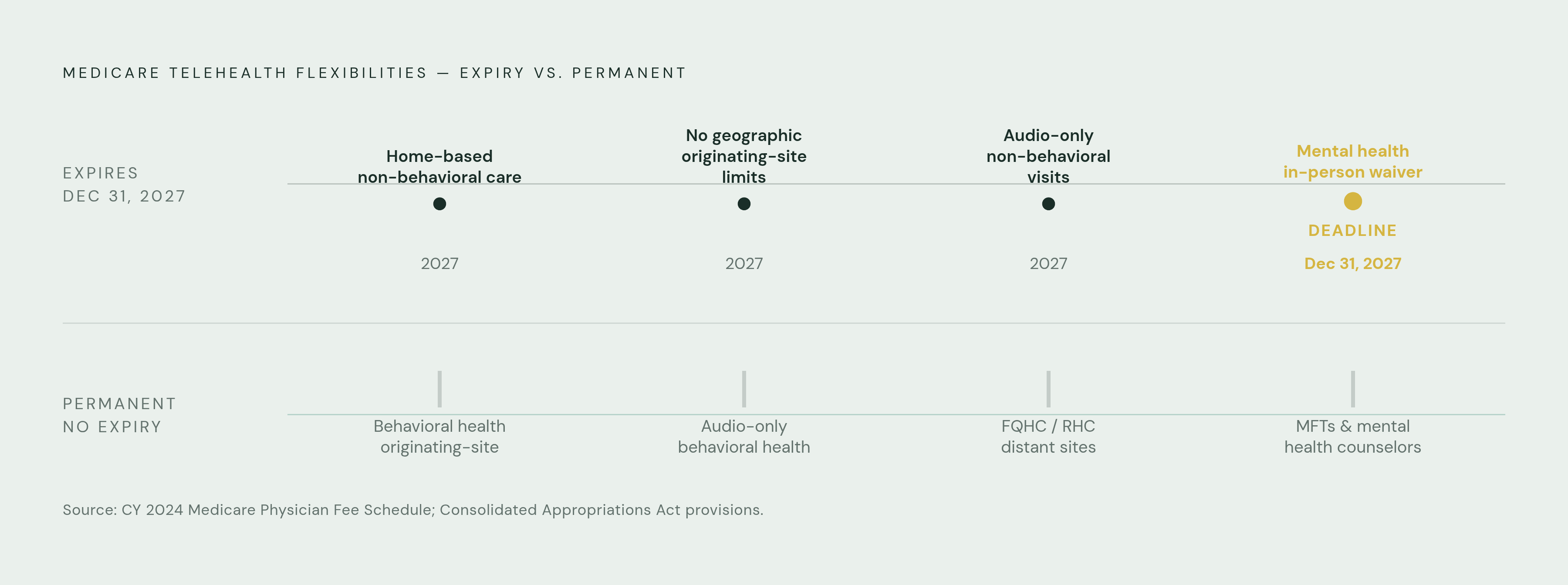
Recent legislation extended a wide set of Medicare telehealth flexibilities through December 31, 2027, and that date is now the real, concrete planning horizon for most group visit programs. Through that date, Medicare patients can get non-behavioral telehealth care at home, there are no geographic restrictions on originating site for non-behavioral or mental telehealth, all eligible Medicare providers can deliver telehealth, FQHCs and RHCs can serve as distant site providers for non-behavioral care, audio-only communication is allowed for non-behavioral telehealth, and the requirement for an in-person visit within six months of an initial behavioral telehealth service (and annually after) is suspended.
A separate set of behavioral health carve-outs are permanent and don't sunset with the rest. No geographic restriction on originating site for behavioral telehealth, patients permanently able to receive behavioral telehealth at home, audio-only permanently allowed for behavioral health when a patient can't or won't use video, FQHCs and RHCs permanently eligible as behavioral distant sites, and marriage and family therapists along with mental health counselors permanently allowed to serve as distant site providers. CMS's CY 2026 update also confirmed that Rural Health Clinics and FQHCs keep getting paid for medical telehealth services through January 1, 2028.
Section 1834(m) of the Social Security Act calls for an in-person, non-telehealth visit within six months before a patient's first mental health telehealth service, a requirement that is easy to miss now while it's still waived. That requirement is suspended through December 31, 2027, but it comes back after that date. Group behavioral health programs should build their enrollment workflow now to accommodate that prerequisite check, rather than scrambling to retrofit it once the waiver expires. Audio-only sessions for non-behavioral group visits remain permitted through the same 2027 deadline, but payers are already drifting toward video as the expected standard, so scheduling systems should flag any audio-only group session for payer-specific billing review rather than assuming it'll clear automatically. Programs that build their scheduling systems to surface these eligibility rules per session type, rather than trusting staff to remember which rule applies to which patient on which date, are the ones that will still be running clean group visits after the flexibilities start expiring.
Sources
- MLN901705 - Telehealth & Remote Monitoring
- How 2026 E/M and Telehealth Rules are Changing | Medwave
- Telehealth FAQ
- Association between the Number of Consecutively Scheduled Telehealth Visits and Video Usage - PMC
- cms.gov
- ama-assn.org
- Introducing Virtual Shared Medical Appointments as a Novel Treatment Platform for Functional Movement Disorders
- New Group Telehealth Appointment